










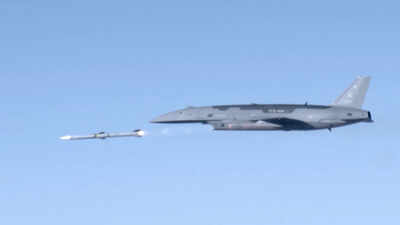
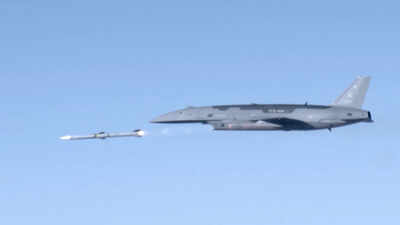
The US Air Force’s YFQ-44A Fury drone, developed by Anduril Industries, has successfully fired its first live AIM-120 Advanced Medium-Range Air-to-Air Missile (AMRAAM).The live-fire test, conducted at Edwards Air Force Base in California, is the first live missile launch by a US Collaborative Combat Aircraft (CCA).The test involved a beyond-line-of-sight strike against a simulated target. The Fury carried the missile externally on wing-mounted hardpoints, and Anduril’s Lattice software enabled autonomous mission execution, including target-data ingestion, operator tasking, and launch.The achievement validates autonomous weapon employment within pilot-defined parameters and demonstrates rapid progress in the CCA program, which aims to integrate drones into frontline air combat.The Fury is part of the first phase of the US CCA program alongside General Atomics’ YFQ-42A Dark Merlin.Both designs have been ordered for production to form the initial operational CCA fleet.The Dark Merlin has yet to conduct a live-fire test but is expected to do so later this year.The Air Force envisions CCAs as force multipliers, extending sensor reach and providing additional combat capacity in high-end conflicts. These unmanned aircraft will support manned-unmanned teaming by flying ahead of crewed fighters to perform kinetic action, electronic warfare, and reconnaissance missions, reducing risk to piloted aircraft and enabling new tactical options.Several countries are working to deploy similar capabilities.In December 2025, Turkey’s Baykar Kızılelma drone fired Gökdoğan air-to-air missiles, including one against a target drone. The Royal Australian Air Force, in partnership with Boeing, recently demonstrated the same capability by test-firing an AMRAAM from an MQ-28 Ghost Bat.India is pursuing its own path with the stealthy Combat Air Teaming System (CATS) Warrior unmanned program.That system has completed ground engine tests and is expected to carry both air-to-air and air-to-surface weapons. Once operational, it will be intended to team with Tejas, Sukhoi-30MKI, Jaguar, and the under-development Advanced Medium Combat Aircraft.Beyond air-to-air combat, unmanned platforms are expanding into terrestrial and maritime domains. Earlier this week, the United States reportedly deployed three Corsair unmanned surface vessels offensively against Iran’s Bandar Abbas port.These developments show autonomous platforms moving toward a central role in modern combat. The Fury’s successful AMRAAM launch is especially significant because it demonstrates the viability of autonomous drones in air-to-air engagements—a domain long dominated by crewed fighters. With nations such as Turkey, Australia, Russia, and India advancing their programs, mixed fleets of autonomous drones and manned aircraft will expand tactical options and improve survivability for forces that deploy them in future conflicts.