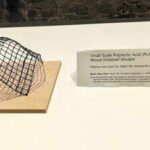







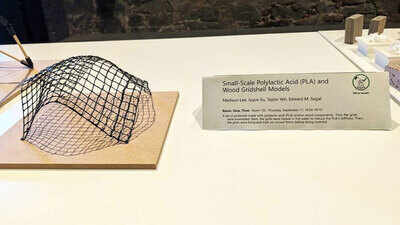
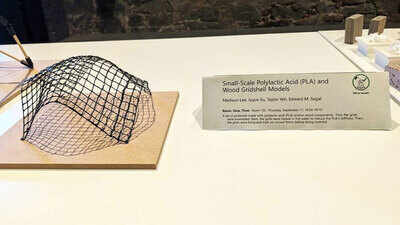
Wooden sticks, hot water and 3D-printed plastic connectors helped three high school students develop a low-cost technique for creating curved architectural structures. Their research, conducted through a summer programme at Hofstra University in the US, was presented at an international engineering conference in Turin, Italy, in September 2026.Madison Lee, Taylor Yeh and Joyce Jia Xu worked with engineering professor Edward Segal from summer 2025, developing and testing models using a process known as heat-based form finding. The students were lead designers and first authors of the research paper, giving them an opportunity to present their work alongside research from established institutions.
How the students turned flat grids into curved structures
The technique uses wooden dowels connected by specially designed 3D-printed plastic connectors. When the models are immersed in hot water, the plastic connectors temporarily soften, allowing the flat grid structures to change shape. The models can then be hung to form curved three-dimensional structures.The students explored how this process could offer a more accessible and energy-efficient alternative to conventional methods of creating curved structures. The approach could help architects and engineers experiment with designs for larger roof structures.The project began through Hofstra University’s Summer Science Research Program, which gives high school students the opportunity to work on practical research under faculty guidance. Although Segal introduced the initial concept, the students took responsibility for designing connectors, conducting experiments and refining their models through repeated testing.Their work was presented at the International Association for Shell and Spatial Structures (IASS) conference in Turin, held from September 14 to 18, 2026. Their models were exhibited alongside work by researchers from institutions including the University of Tokyo, Vrije Universiteit Brussel and the Massachusetts Institute of Technology.
Research experience influences student’s college choice
For Madison Lee, the programme also helped determine what she wanted to study after school. She entered the research programme without previous engineering experience but developed an interest in design through prototyping, 3D printing and scientific writing.A graduate of Plainview-Old Bethpage John F. Kennedy High School, Lee is now studying integrated design and media at New York University’s Tandon School of Engineering. She said the experience directly influenced her choice of college major.The international presentation was another milestone. Lee said she had not expected something she helped create to reach an international engineering conference.
Professor’s former student makes an unexpected appearance
The Turin conference also brought Segal together with David Gallego, a 2022 Hofstra alumnus who was presenting research based on his master’s thesis at the University of Stuttgart in Germany.Gallego credited Segal’s guidance during his undergraduate years with introducing him to computational design and timber systems. That exposure encouraged him to pursue further study in Germany, where he spent three years and expanded his academic and personal experiences.For Segal, the meeting brought together two generations of students whose paths had been influenced by mentorship. He described it as a continuing relationship in which students eventually become collaborators and colleagues, while also creating opportunities for the next generation.The experience in Turin thus marked more than an international presentation for the three high school researchers. It showed how an early opportunity to work on a practical engineering problem can lead to research exposure and, in some cases, influence a student’s future academic choices.Source: Hofstra University. The research was presented at the IASS conference in Turin; the university announcement does not establish that the technique has been adopted for commercial construction.