









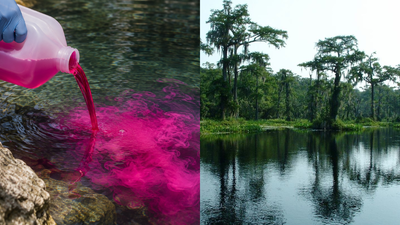
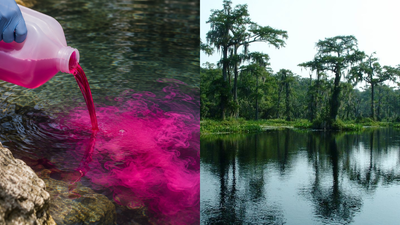
A dye was injected into a sinkhole beneath Florida’s Lake Jackson and took about five weeks to reach Wakulla Spring, which was evidence that water can move between the two sites through the underground limestone aquifer. The lake is about 19 miles north of Wakulla Spring, and researchers detected distinctive Rhodamine WT dye signals at the spring 35 days after the injection, according to a 2024 study in the Journal of Cave and Karst Science.Lake Jackson is a shallow, perched lake, while Wakulla Spring is fed by the Upper Floridan Aquifer. The Woodville Karst Plain lies between them, where groundwater can travel through fractures and other openings in the limestone. Researchers Seán E. McGlynn and Alan W. Niedoroda injected the dye into a lake-bottom sinkhole on September 19, 2017. The injection lasted 6.5 minutes, and instruments at Wakulla Spring and nearby Sally Ward Spring later recorded the dye.
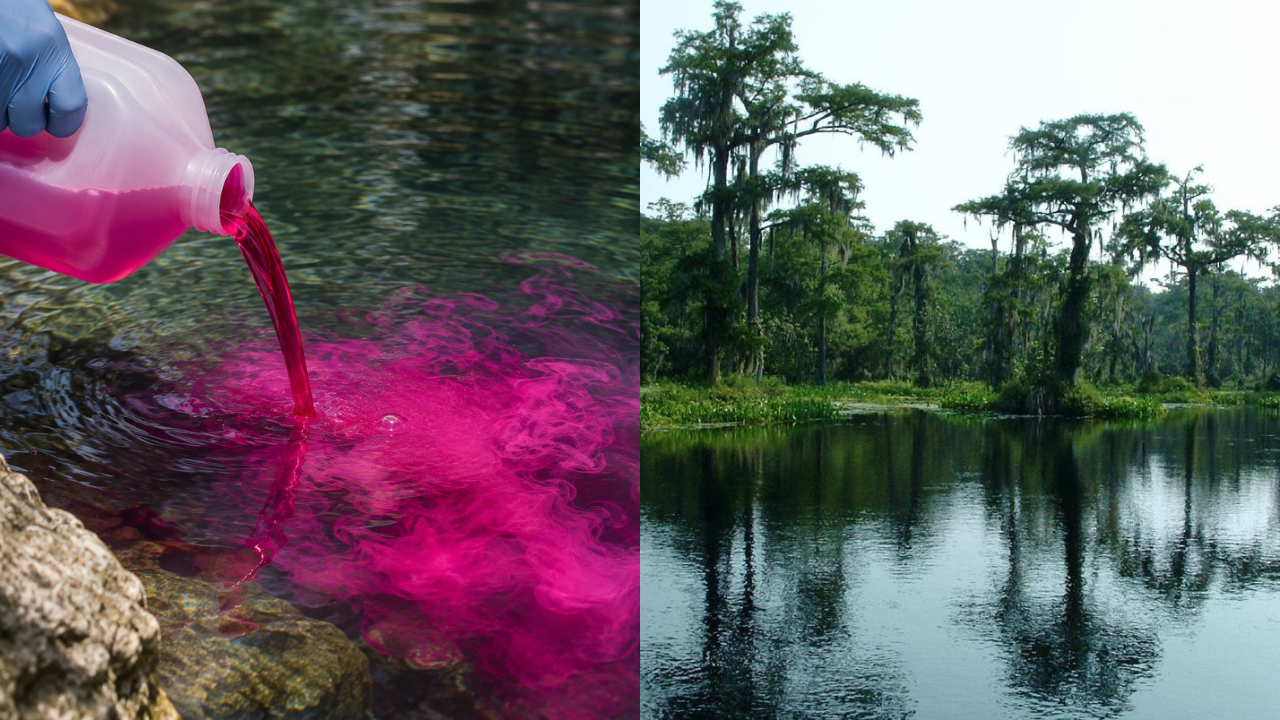
LEFT (AI Representation): A dye was injected into a sinkhole beneath Florida’s Lake Jackson | ChatGPT; RIGHT: Wakulla Spring | Wikimedia Commons
The dye followed water undergroundRhodamine WT is a fluorescent tracer that can be detected at very low concentrations, and researchers could follow the chemical signature after it entered the aquifer instead of trying to see the water itself moving underground. The strongest distinctive dye concentration peaks at Wakulla Spring and Sally Ward Spring appeared 35 days after the Lake Jackson injection. Researchers also found dye in charcoal packs placed at those springs and three other nearby springs.The findings indicated that some of the injected dye had moved through an aquifer conduit-like system, and the researchers estimated an average flow speed of about 0.8 kilometers per day along the relevant underground pathway. The study also found that the dye appeared at five separated springs, which the researchers said indicated a braided and branching conduit system. Water moving through limestone does not necessarily follow a uniform underground channel; some water can move rapidly through larger openings, while other portions spread through the surrounding rock.Lake Jackson sits over the Floridan AquiferThe Florida Department of Environmental Protection has specifically identified the Lake Jackson sinkholes as places where water can enter the aquifer. In an August 2021 announcement, the Florida Geological Survey said a dry-down of Lake Jackson had exposed Porter Hole Sink and created an opportunity to study where the lake water went after entering the Upper Floridan Aquifer. The department noted that the same aquifer supplies drinking water to people in Leon and Wakulla counties and feeds springs such as Wakulla Spring.The 2021 announcement referred to an earlier dye trace that had indicated a possible connection between Lake Jackson and Wakulla Spring, and the state planned another dye release at Porter Hole Sink to investigate the connection further. It showed that studying groundwater in a karst system is difficult, since a lake can appear isolated at the surface while water beneath it moves through a network that is invisible from above.Wakulla Spring receives water from a large areaWakulla Spring is one of the largest springs in Florida and is the main source of water for the Wakulla River. Florida State Parks estimates that the spring discharges about 300 million gallons of water each day from the Upper Floridan Aquifer.The state also estimates the watershed supplying Wakulla Spring at about 975 square miles, and surface water entering the aquifer through sinkholes and other openings can later emerge at the spring. Dye tracing has been used to establish underground connections elsewhere in the Wakulla Spring watershed. Florida State Parks says previous studies have verified that water entering four major swallets later discharges at Wakulla Spring. Lake Jackson therefore was part of a much larger groundwater system in which surface water can disappear underground and re-emerge many miles away.
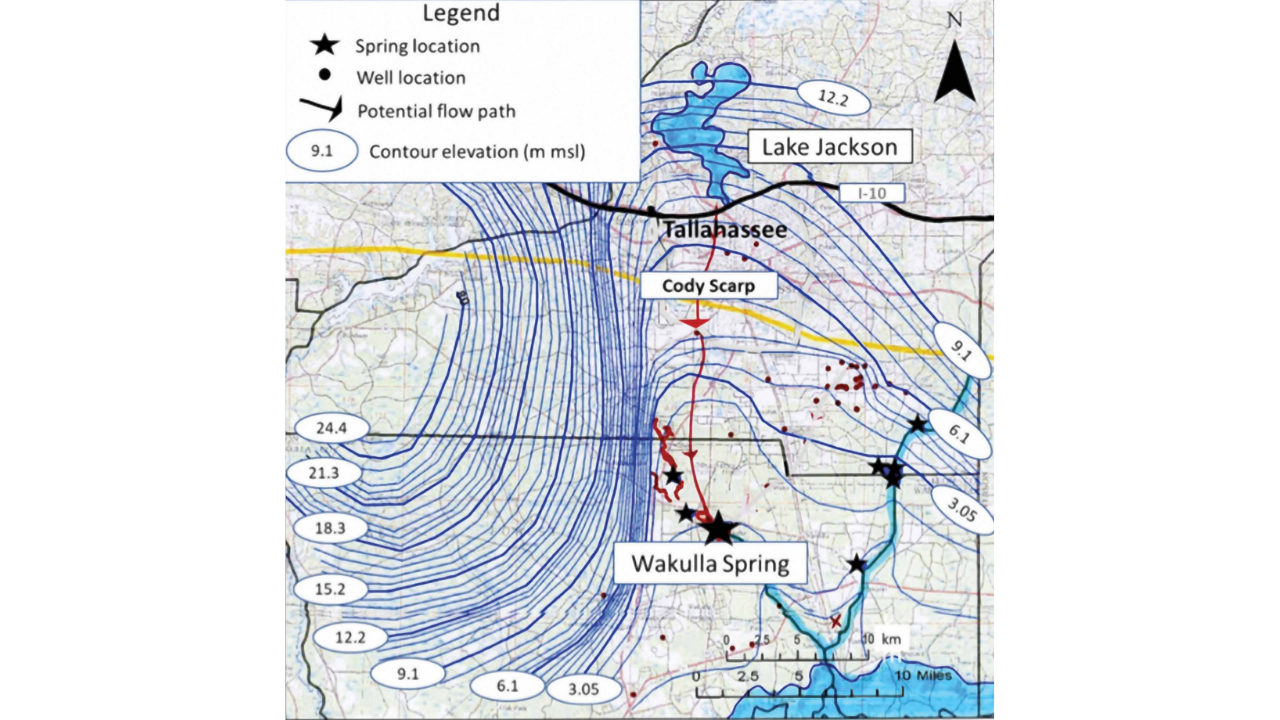
Upper Floridan Aquifer piezometric contours for October–November 1991 (redrawn from map in Chelette et al., 2002 and Davis, 1996) in the project area | Journal of Cave and Karst Studies
Most of the dye did not reach Wakulla SpringThe 2017 experiment did not show that all of Lake Jackson’s water travels directly to Wakulla Spring; in fact, the researchers found that only a small fraction of the injected dye reached Wakulla Spring. Their analysis indicated that much of the dye dispersed into the limestone matrix instead. The study concluded that there was evidence of a connection between Lake Jackson and several Wakulla County springs, but it characterized the work as exploratory and said the actual dye-mass balance could only be described conjecturally.The measured travel time nevertheless provided a field observation of water movement over a distance of roughly 30 kilometers. The researchers estimated that the conduit-like flow responsible for the detections could transport water at an average rate of 0.8 kilometers per day. The experiment also has implications for how contaminants might move through the region’s groundwater, as the study said the same types of underground pathways that move water can transport nutrients and pollutants over long distances.