










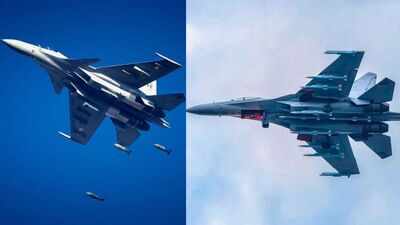
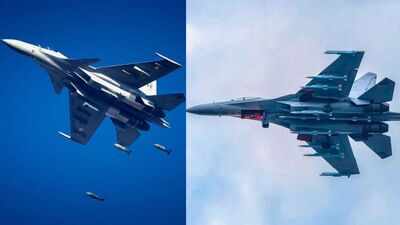
India’s Su-30MKI and China’s J-16 may fly under different flags today, but both trace their origins to the same Soviet-era Flanker family. Descended from the legendary Su-27, the two heavyweight fighters have evolved into the backbone of the Indian Air Force (IAF) and the People’s Liberation Army Air Force (PLAAF), reflecting two distinct approaches to modern aerial warfare.India transformed the Su-30MKI into a highly agile multirole fighter by integrating Russian, Israeli, French and indigenous technologies. China, meanwhile, developed the J-16 into a modern strike fighter equipped with indigenous radar, electronic warfare systems and long-range weapons.Although they share the same Flanker DNA, decades of upgrades have turned them into fundamentally different combat aircraft.As military competition between Asia’s two largest powers intensifies and both countries continue to modernise their air forces, comparisons between the two fighters have become increasingly relevant. If the Su-30MKI and the J-16 were to face each other, which aircraft would hold the advantage?
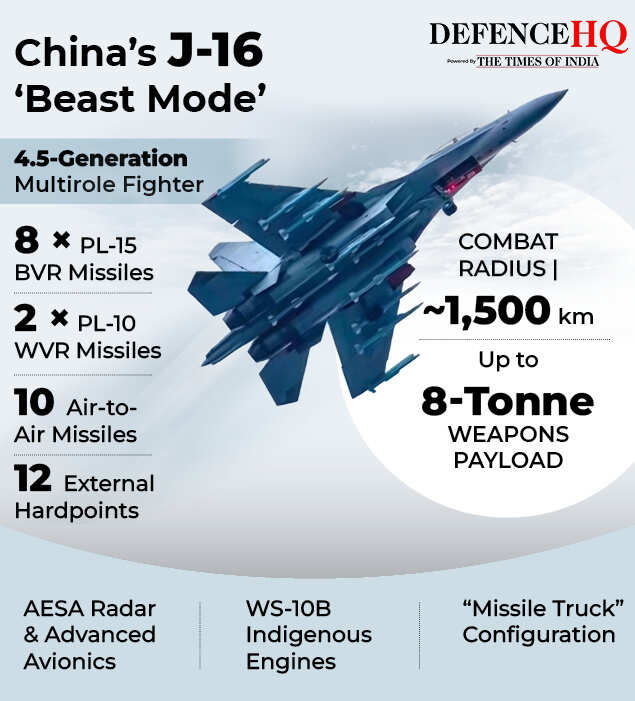
J16 fighter jet
Evolution of the two Flankers
The J-16 traces its roots to the late 1990s, when China acquired the Russian-built Su-30MKK, an export variant of the Su-30.Drawing on operational experience with the Su-30MKK and the earlier J-11 programme, the Shenyang Aircraft Corporation developed an indigenous multirole fighter that retained the proven Flanker airframe while replacing many of its critical systems with Chinese-developed technologies. These include avionics, mission computers, radar, electronic warfare equipment and weapons integration.Although externally similar to the Su-30MKK, the J-16 is widely regarded as a far more advanced platform. It features an Active Electronically Scanned Array (AESA) radar, improved electronic warfare capabilities, modern data links and compatibility with China’s latest air-to-air and precision-guided weapons.Today, the J-16 has become one of the PLAAF’s principal multirole fighters, with open-source estimates suggesting that more than 300 aircraft are in service.India followed a different path with the Flanker family.Instead of designing a new aircraft, New Delhi customised the Su-30MKI into a uniquely Indian platform by combining the Russian airframe with French navigation systems, Israeli avionics and electronic warfare equipment, along with an increasing number of indigenous systems developed over the past two decades.With more than 260 aircraft in service, the Su-30MKI remains the backbone of the IAF. Its planned “Super Sukhoi” upgrade programme, which includes a new indigenous AESA radar, upgraded avionics and enhanced weapons integration, is expected to keep the aircraft operational well into the 2040s.
Head-to-head comparison
Airframe and design
The Su-30MKI’s biggest design advantage lies in its canards and thrust-vectoring engines, which give it exceptional agility, especially during high-angle-of-attack manoeuvres.The J-16 retains the Flanker airframe but incorporates greater use of indigenous materials and is optimised for carrying heavier payloads and more advanced electronic systems. Unlike the Su-30MKI, it does not feature canards.
Engines and manoeuvrability
The Su-30MKI is powered by two Russian AL-31FP afterburning turbofan engines, each producing around 125 kN of thrust with afterburner. These engines are also manufactured under licence by Hindustan Aeronautics Limited (HAL).The J-16 uses China’s indigenous WS-10 series engines, believed to be the WS-10B or the newer WS-10C in later production aircraft. Although they lack thrust-vectoring capability, Chinese engine reliability has improved considerably over the past decade.In close-range dogfights, the Su-30MKI’s thrust-vectoring gives it a clear manoeuvrability advantage.
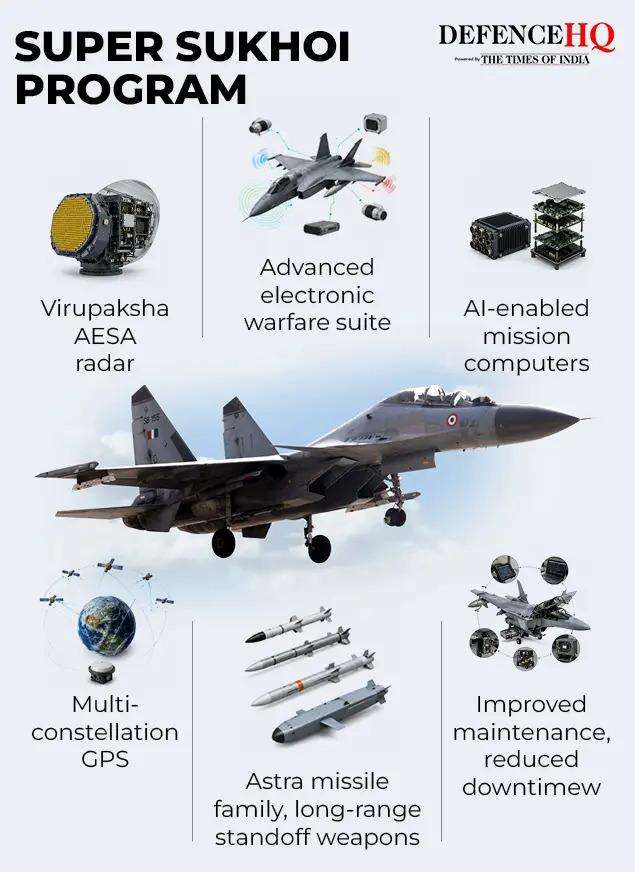
Super Sukhoi program
Radar
The Su-30MKI is equipped with the NIIP N011M Bars Passive Electronically Scanned Array (PESA) radar. While capable of tracking multiple targets simultaneously and performing both air-to-air and air-to-ground missions, it represents an earlier generation of radar technology.The upcoming Super Sukhoi upgrade will replace it with an indigenous AESA radar.The J-16 already operates with an indigenous AESA radar. Although China has not disclosed detailed specifications, AESA technology generally offers faster beam steering, superior resistance to jamming, greater reliability and better multi-target tracking than older PESA systems.
Electronic warfare
The Su-30MKI employs a mix of Russian, Israeli and Indian electronic warfare systems that have been upgraded over time. However, many of its core components date back to the early 2000s and are due for replacement under the Super Sukhoi programme.The J-16, by contrast, was designed from the outset with modern electronic warfare capabilities. China has also developed the dedicated J-16D electronic attack aircraft, underscoring the maturity of its electronic warfare ecosystem and the PLAAF’s focus on suppressing enemy air defences.
Weapons
The Su-30MKI carries a wide range of weapons, including the Astra Mk-1 beyond-visual-range missile, R-77 and R-73 air-to-air missiles, the BrahMos supersonic cruise missile and the Rudram anti-radiation missile. This diverse arsenal makes it one of the IAF’s most versatile strike platforms.The J-16 is integrated with China’s latest air-to-air weapons, including the PL-10 short-range missile and the long-range PL-15. Equipped with an AESA seeker, the PL-15 is widely regarded by Western defence analysts as one of the most capable operational beyond-visual-range missiles in service.
Which fighter has the edge?
The answer depends on the nature of the engagement.In a within-visual-range dogfight, the Su-30MKI’s thrust-vectoring engines, canards and exceptional manoeuvrability could give it a decisive advantage.Modern air combat, however, is increasingly decided long before opposing fighters come within visual range. In beyond-visual-range engagements, the J-16 currently appears to hold the advantage thanks to its AESA radar, more advanced electronic warfare suite, superior networking capabilities and the long-range PL-15 missile.That said, India’s planned Super Sukhoi upgrade aims to narrow many of these gaps by introducing an indigenous AESA radar, modern avionics, upgraded electronic warfare systems and enhanced weapons integration, ensuring the Su-30MKI remains a formidable air superiority fighter for decades to come.