












India’s foreign exchange reserves are climbing to new record highs, thanks to the RBI’s FCNR(B) deposits scheme that has resulted in bumper inflows. Forex reserves are an important buffer that can help the central bank control any rapid decline in the rupee.In fact, earlier this month when the news of record inflows came in, the rupee rallied strongly to a two-month high. India’s forex reserves hit a record $785.71 billion in the week of September 4, 2026, jumping $44.9 billion in a single week – the biggest weekly rise ever. This has been due to the record $136.38 billion that has come in through the central bank’s special dollar swap scheme which it launched in June.But that strength in the rupee has failed to hold. The currency is now hovering back to its two-month lows. While the RBI is intervening to prevent major volatility, the fact is the rupee is still facing immense pressure, and experts believe the currency is unlikely to appreciate much any time soon.
Why is the rupee stuck?
The rupee is stuck around the 95.7-96/dollar range. Why the mismatch with the record forex reserves data?What needs to be understood is that the forex reserves that the RBI has built through the FCNR-B deposits sit parked on the RBI’s books rather than actually being traded in the open market.Divya Mandaliya, Commodities & Currencies Research Analyst, Anand Rathi Share and Stock Brokers explains that most of the jump in forex reserves came from the RBI’s special NRI deposit scheme (FCNR-B), where banks swap dollars directly with the RBI instead of selling them in the open market.“So the reserve number swells, but that cash never becomes a real dollar supply that could push the rupee up,” she tells TOI.Back in March 2026, the RBI sold dollars hard to defend the rupee during the Middle East-driven oil shock. Forex reserves dropped by more than $100 billion in just weeks, sliding to $666.9 billion by late June.But, despite all that spending, the rupee still hovered near record lows of 96.67 on July 24, 2026, not far off the all-time low of 96.96 hit back on May 20, 2025, she notes.That’s the real lesson here: spending reserves can slow a crash, but it doesn’t stop one. A big reserve number is a sign of capacity, not control.“The RBI can smooth out a sharp, sudden spike- but against a grinding, ongoing drag like expensive oil, a wide trade gap, or FIIs heading for the exit, reserves buy time, not a floor. Think of it as a tool to slow the fall, not reverse it,” she says.
Factors pulling rupee down
Record foreign exchange reserves have provided the RBI with sufficient room to keep the rupee’s volatility under check, but fundamental factors are pulling the currency down.These are: a widening trade deficit due to a constant stream of dollar buying by imports for oil and even gold. Foreign investors have been pulling out money aggressively.India’s merchandise trade gap ran wide through 2026: $30.4 billion in June, $32 billion in July, easing to $26.86 billion in August as exports picked up. CForeign investors pulled out roughly $29-30 billion from Indian equities, the largest annual outflow on record. Then in July-August, they actually turned net buyers, bringing around $5.2 billion back into Indian equities.September has flipped it back to selling: fresh West Asia tensions have pushed Brent crude past $109/barrel, and FIIs pulled out Rs 13,138 crore in just the first two weeks of the month.That resumed selling pushed the year-to-date total back up to Rs 2.37 lakh crore (~$27 billion) – well above the Rs 1.66 lakh crore withdrawn in all of 2025.Divya Mandaliya sees it as a tug of war: On one side, the RBI is building a bigger dollar buffer. On the other side, oil bills, heavy imports, and nervous foreign investors keep pulling dollars out.Ranen Banerjee, Partner and Leader, Economic Advisory, PwC India explains that the global demand for dollars is also a big factor along with attractive US bond yields that make investment in Indian markets less lucrative.“The exchange rate is determined by the demand for dollars globally, which pushes the dollar strength upwards. The market was pricing in the US Federal Reserve policy rate increase that was announced. The US Fed has indicated another rate increase this year. The challenge is the fact that inflation in the US is very high and it continues to be pushed up by the higher crude oil prices,” Banerjee tells TOI.The yield differential between the US and India has also narrowed and is less than 2 percentage points.“Institutional investors getting a 5% dollar return would not put money in India to get a 7% rupee return and hence an outflow of dollars. In addition, there is a higher dollar requirement for imports to India with elevated oil and commodity prices. A combination of these factors is keeping downward pressure on the rupee,” he explains.Also, the RBI has always been clear that it does not target any particular level for the rupee and works only to contain volatility.US Treasury yields at a 19-year high of 5.02% make a huge difference, say experts.
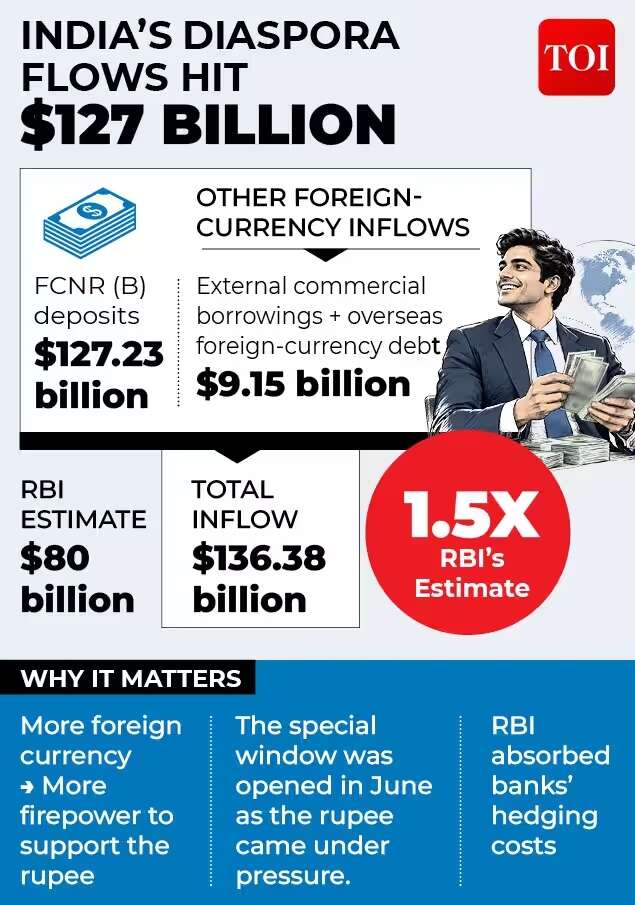
India’s diaspora flows climb on FCNR-B deposit schemes
“Global investors can now earn strong, safe returns just by holding US bonds, so less money flows into emerging markets like India. The Dollar Index, trading near 99.4-99.7, close to a multi-week high, is a direct reflection of that shift in money,” says the Anand Rathi expert.According to DK Srivastava, Chief Policy Advisor at EY India, there is an expectation that given persistent increases in consumer price inflation in the US, the Fed rate may progressively attract dollars from other countries including India back into the US.“At the same time, with increasing risks associated with growing US government debt, many countries are reducing their holdings of US treasuries. As these tendencies gather further momentum, there may be a scarcity of US dollars in major trading partners such as India leading to continued exchange rate pressure,” he tells TOI.
Crude oil vulnerability
One factor that warrants separate mention is India’s dependence on imports to meet its crude oil supply. Oil prices are rising again, and so is India’s import bill, and that vulnerability cannot be easily wished away.Since India buys about 85% of its oil from abroad, that price spike hits the currency almost instantly: more imports to pay for, more dollars needed, more pressure on the rupee.In fact, Divya Mandaliya sees the trade gap and the FII selling both coming back to this same oil story: Expensive crude widens the trade deficit. It also scares off global investors, which is exactly what triggered the fresh wave of foreign selling in September.And then there is the factor of a US tariff threat looming over Russian crude oil buys.
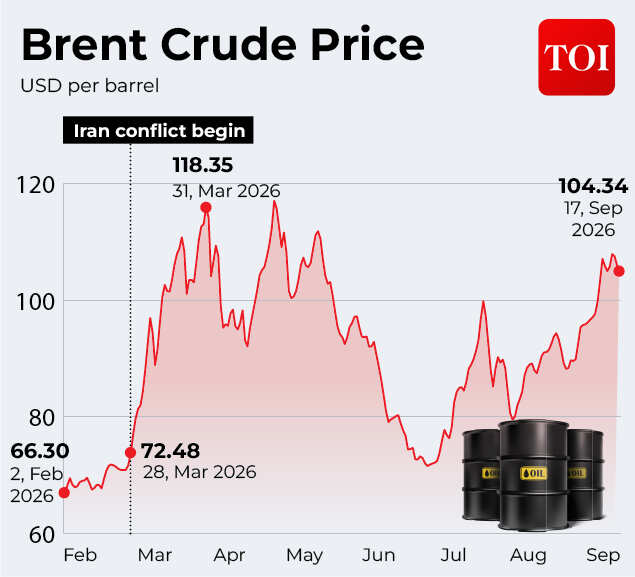
Brent Crude Price Trendline Since Start of US-Iran War
“Continued dependence on large oil imports from Russia may lead to substantial hikes in US tariffs. Further, the present situation in the Middle East warrants progressively higher crude prices and uncertain supplies,” says DK Srivastava.India is likely to prioritise minimum disruption in crude oil imports and may prefer to continue importing from Russia, the US tariff threats notwithstanding.“It will have to manage its peculiar combination of trade deficits with China and Russia and trade surplus with the US. With the tariffs, this trade surplus would go down and with a higher proportion of local currency trade, rupees will accumulate in the accounts of both China and Russia. If investment by these two countries is facilitated, India may be able to absorb the excess rupee holdings of China and Russia while dealing with lower dollar inflows due to higher US tariffs,” says EY’s Srivastava.
What’s the road ahead?
The important thing to understand is that while holding record foreign exchange reserves provides a good import cover and builds fundamental credibility, it does not eliminate the impact of market forces on the rupee.Also, the central bank’s objective is generally to smooth excessive volatility and ensure orderly market functioning rather than resist every market-driven movement in the exchange rate.Ramen Banerjee is of the view that forex reserves should never be used to defend the currency.“They should be used judiciously to contain speculation and that has been the stand of the RBI. The reserves provide a cushion for exigencies and also provides confidence to investors and exporters to India on the macro fiscal stability of the country,” he says.Experts are clear that India’s stock of foreign exchange reserves provides substantial protection against external shocks.But, DK Srivastava says the critical question is the timing of the RBI’s intervention. “With the expectation of a tariff hike linked to continued oil imports from Russia, the RBI may determine the timing of its intervention based on market developments as they evolve,” he says.In the short-run, higher Fed rate and higher US tariffs are the most critical determinants driving down the value of rupee.“In the medium to long run, India’s strategy should be to shift to trade in national currencies and better manage its portfolio of inter country trade imbalances and investment flows,” he says.As Divya Mandaliya concludes: At $785.7 billion, India’s forex reserves are a solid safety net- enough to pay for roughly 11 months of imports if trade flows suddenly stopped.They also comfortably cover most of what India owes the world in external debt. Together, that gives the RBI real firepower to step in and manage the rupee during periods of global stress.But, using those reserves is a whole different ballgame.