








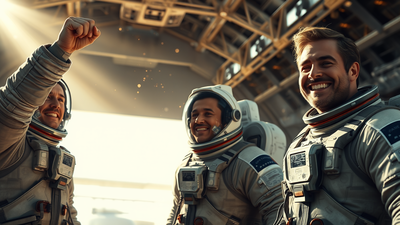
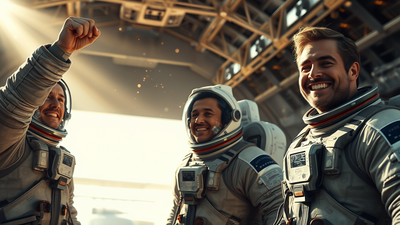
NASA astronaut Chris Williams has returned to Earth after completing an eight-month science mission aboard the International Space Station, landing safely in Kazakhstan alongside Roscosmos cosmonauts Sergey Kud-Sverchkov and Sergei Mikaev. The crew spent 241 days in orbit, during which they completed 3,856 trips around the planet and travelled more than 102 million miles. Their Soyuz MS-28 spacecraft touched down southeast of Dzhezkazgan after undocking from the station earlier that morning, bringing to a close a mission that included two spacewalks and a wide range of scientific research. The flight marked the first spaceflight for both Williams and Mikaev, while it was the second mission for Kud-Sverchkov.
How the Soyuz MS-28 crew landed in Kazakhstan
According to a NASA press release, the crew undocked from the space station at 2:03 am before making a parachute-assisted landing at 5:27 am CDT, which corresponded to 3:27 pm local time in Kazakhstan. The Soyuz MS-28 capsule came down southeast of the town of Dzhezkazgan, the same general region where Soyuz landings have taken place for decades. NASA had earlier confirmed in a separate mission coverage release that the spacecraft was scheduled to undock from the station’s Rassvet module before beginning its descent toward the Kazakh steppe.The 241-day mission began when Williams, Kud-Sverchkov and Mikaev launched to the International Space Station on November 27, 2025. Over the course of their stay, they orbited Earth 3,856 times, a figure NASA confirmed alongside the total distance travelled of more than 102 million miles, roughly equivalent to more than 200 round trips to the Moon.
What research Chris Williams carried out on the space station
During his time aboard the orbiting laboratory, Williams took part in a wide range of scientific investigations and technology demonstrations, according to NASA. His work included research aimed at supporting the development of new cancer treatments, alongside experiments focused on improving the production of materials used in high-performance computers and electronics manufactured in the microgravity environment of space. Williams also carried out two spacewalks during the mission, contributing to the ongoing maintenance and upgrade work that keeps the two-decade-old station operational.This kind of research is central to why NASA continues to fund long-duration missions aboard the International Space Station. Materials and biological processes behave differently in microgravity, allowing scientists to study things that are difficult or impossible to replicate under Earth’s gravity, from how cancer cells grow to how certain high-value electronic components can be manufactured with fewer defects.
Why the International Space Station mission matters for future Moon and Mars plans
NASA has stated that the International Space Station has supported continuous human presence in orbit for more than 25 years, making it one of the longest-running scientific platforms ever built. Missions like the one completed by Williams, Kud-Sverchkov and Mikaev are described by the agency as directly feeding into preparations for longer duration spaceflight, including missions to the Moon under the Artemis programme and eventual crewed missions to Mars.Long stays aboard the station allow researchers to study how the human body adapts to extended periods in microgravity, from changes in bone density and muscle mass to shifts in the immune system, all of which are critical considerations before astronauts can be sent on multi-year journeys further into the solar system. The station also gives NASA a way to test life support systems, food production methods and other technologies that will eventually need to function reliably far beyond low Earth orbit.
What happens next for the returning crew
Following touchdown, the crew was expected to undergo standard post-mission medical checks, a routine procedure for astronauts and cosmonauts readjusting to Earth’s gravity after an extended stay in space. Left aboard the International Space Station were NASA Crew 12 commander Jessica Meir, astronaut Jack Hathaway, European Space Agency astronaut Sophie Adenot and Roscosmos cosmonaut Andrey Fedyaev, who took over station operations following a change of command ceremony shortly before the Soyuz crew departed.With Williams’s first spaceflight now complete, NASA’s research pipeline aboard the space station continues uninterrupted, with new crews rotating in as the agency keeps building the scientific and technical foundation it says will be needed for the next era of human spaceflight beyond low Earth orbit.