







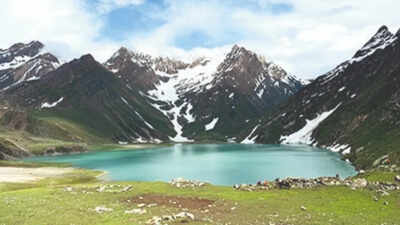
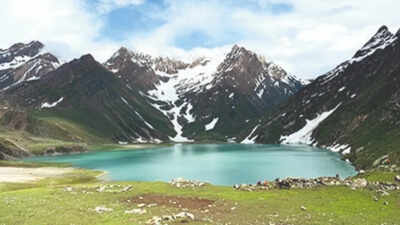
The controversy surrounding the Border Roads Organisation’s (BRO) work near Sheshnag Lake has raised an important question about environmental protection in Kashmir. Situated at approximately 3,590 metres, the lake is ecologically fragile and holds deep religious significance for Hindu devotees. Its protection must not be trivialised. Every intervention in such a sensitive Himalayan landscape deserves scrutiny, transparency and compliance with environmental safeguards. But environmentalism cannot be reduced to the visibility of an excavator, nor can the ecological history of an entire region be judged through a single controversy.From the disappearance of wetlands in the 1990s to forest diversion, the Jhelum Flood Spill Channel and the latest controversy over the Amarnath track, Kashmir’s environmental record demands a much wider examination. If the argument is genuinely about Kashmir’s environment, the discussion must go beyond Sheshnag. It must confront what has happened to Kashmir’s wetlands, forests, rivers, floodplains and natural drainage systems over the last three decades, as well as the record of the political parties that governed Jammu and Kashmir during those years. Otherwise, environmental protection risks becoming less a consistent public principle and more a selectively deployed political instrument. The evidence raises an uncomfortable question: why has Kashmir’s wider environmental destruction not generated the same political intensity as the present controversy over a pilgrimage route?The 2026 CAG Audit ReportPerhaps the most consequential evidence comes from the CAG’s Report No. 4 of 2025, presented on 30 March 2026, which examined the conservation and management of Jammu and Kashmir’s lakes for 2017–22.The report covered 697 natural lakes, yet conservation and management programmes existed for only six: Dal, Wular, Hokersar, Manasbal, Surinsar and Mansar. The remaining 691 had not been adequately identified for central assistance or covered by corresponding plans.Other findings were equally concerning. Of 63 lakes examined through satellite imagery, seven were no longer visible or had almost dried up. Hokersar had 2,528.10 kanals of encroached lake area, attributed by the audit to the absence of proper survey and demarcation. Surinsar and Mansar remained vulnerable to encroachment, while untreated sewage entered the lakes because sewage-treatment facilities were absent. The audit also identified the absence of a centralised lake authority and a specific legal framework for lake conservation.These are findings of an independent constitutional auditor. They should command the attention of every political party, environmental organisation and public representative. Where is the sustained political urgency over 691 lakes without conservation programmes, seven lakes that have nearly disappeared and thousands of kanals of encroached wetland?An ecological inheritance disappearing before our eyesKashmir’s environmental decline is neither recent nor attributable to a single administration. It is the accumulated consequence of decades of encroachment, unplanned urbanisation, inadequate conservation, weak enforcement and development that too often failed to account for ecological costs. Historical figures are particularly revealing. According to data from the Department of Environment and Remote Sensing, reproduced in the 2014 flood assessment and subsequent planning research, Kashmir’s marshland and water-body area underwent a dramatic reduction between 1911 and 2011.
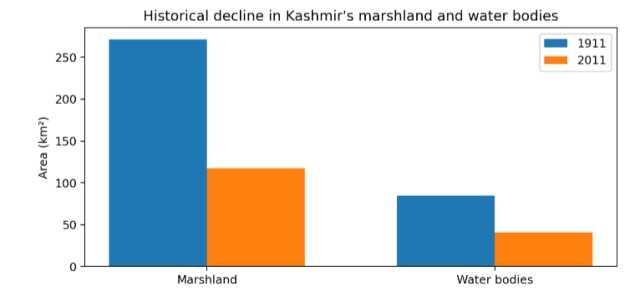

The combined area declined by approximately 55.6 per cent. Wetlands are natural flood absorbers, biodiversity habitats and essential components of the Valley’s hydrological system. Their disappearance weakens the landscape’s ability to absorb excess rainfall and regulate water flows. The September 2014 floods demonstrated the consequences of that vulnerability. The official satellite-based flood assessment discussed the loss of wetlands, degradation of forests and conversion of floodplains into built-up areas. It also observed that housing colonies constructed in the Jhelum floodplain had been regularised by successive governments, encouraging further conversion of the remaining wetlands.The period of ecological deterioration crossed successive administrations. Jammu and Kashmir experienced Governor’s and President’s Rule during the early 1990s, followed by the National Conference government under Farooq Abdullah from 1996 to 2002. The PDP–Congress coalition came to power in 2002, with Mufti Mohammad Sayeed as Chief Minister until 2005 and Ghulam Nabi Azad thereafter until 2008. The National Conference–Congress government under Omar Abdullah governed from 2009 to 2015.These administrations were politically different, but none can be separated from the responsibility of protecting Kashmir’s ecological inheritance. The wetlands did not disappear in a political vacuum.The 1990s and early 2000s: A crisis that was allowed to deepenDuring the early 1990s, Jammu and Kashmir was under Governor’s and President’s Rule amid severe political and security instability. Institutional disruption made environmental governance particularly difficult. But the ecological consequences did not disappear with the return of elected government. Under Farooq Abdullah’s National Conference government from 1996 to 2002, Dal Lake encroachment, urban expansion and sewage-management challenges remained unresolved. The PDP–Congress coalition that followed, under Mufti Mohammad Sayeed, inherited these problems but was equally responsible for making conservation an enforceable governance priority.The CAG’s 2011 audit of the Dal Lake Conservation Programme exposed serious weaknesses in sewerage infrastructure. The original project design had failed to provide essential house-to-house sewer connectivity. Although substantial sewer lines and treatment facilities were developed, inadequate connections meant household sewage continued to enter Dal Lake. The audit also criticised the programme’s planning and execution. The problem was not simply a lack of money, but the gap between announced conservation projects and their actual ecological outcomes.The September 2014 floods were a watershed moment in Kashmir’s environmental history. The National Conference–Congress government led by Omar Abdullah was in office when the disaster struck. The scale of destruction exposed the vulnerability of the Jhelum basin, the consequences of urban expansion and the diminished capacity of wetlands to absorb floodwaters.The 2014 assessment highlighted forest-cover loss and the conversion of floodplains and wetlands into built-up areas. It also referred to the regularisation by successive governments of colonies constructed along the Jhelum and its floodplain.The lesson should have been unmistakable: Kashmir’s natural drainage system is not vacant land awaiting development. Wetlands, floodplains and marshes are part of the region’s essential infrastructure.The period from 2015 to 2018 deserves particular examination because it provides a documented example of how development and environmental costs intersected under a government whose leaders are now among the most vocal critics of the Sheshnag work. Mufti Mohammad Sayeed returned as Chief Minister in March 2015 at the head of the PDP–BJP coalition. Following his death in January 2016, Mehbooba Mufti became Chief Minister in April 2016. Her government continued to pursue tourism development, flood-management projects and infrastructure expansion. The Jhelum-Tawi Flood Recovery Project was an important initiative. The proposal for approximately ?1,500 crore in World Bank assistance was approved during Mufti Sayeed’s tenure. Mehbooba Mufti subsequently directed the acceleration of Jhelum flood-management works and riverfront development. A significant figure emerged from a 2017 presentation to the Jammu and Kashmir High Court concerning land acquisition for the Jhelum Flood Spill Channel: 43,800 trees were recorded as cut down in connection with the project, during Mehbooba Mufti’s tenure as Chief Minister.
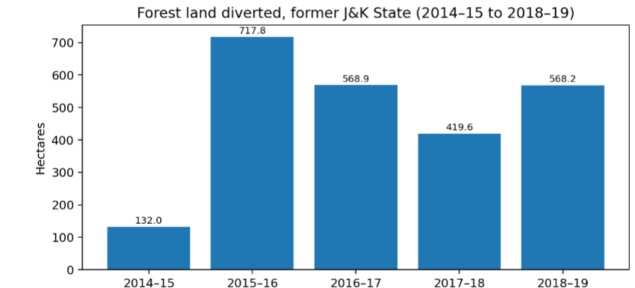
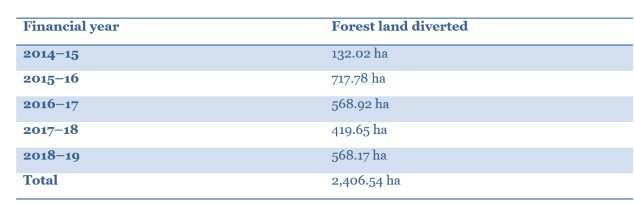
The 43,800-tree figure is project-specific, not a consolidated Valley-wide total. The purpose is not to argue that flood-management projects should have been abandoned, but to ask whether ecological costs were fully assessed, alternatives considered and compensatory measures made effective. J&K CAMPA records show that 2,406.54 hectares of forest land were diverted between 2014–15 and 2018–19. These figures cover the former State of Jammu and Kashmir, not the Kashmir Valley alone. They record forest land diverted for non-forest purposes and should not be misrepresented as proof that every hectare was physically cleared.A wider CAMPA record identifies 13,903 hectares diverted between 1990 and 30 October 2019. This covers several administrations and a much longer period. The 2,406.54-hectare figure is part of that wider historical record and must not be added to it. Forest diversion was not a problem that belonged to one government. It continued through successive administrations, including those now participating in the debate over Sheshnag. The question is why the same insistence on environmental accountability was not consistently applied to these projects.When planting trees becomes a statistic rather than restorationCAMPA figures supplied for this analysis record 173.28 lakh plants as planted and 24,543 hectares treated during 2014–19. Yet an audited plantation programme in Bijbehara reportedly recorded only 10 per cent survival. This is a specific audited finding, not a Valley-wide survival rate.The CAG’s Compliance Audit Report No. 4 of 2021 identified shortcomings in compensatory afforestation and the use of CAMPA funds. It recorded that 2,757.78 hectares of forest and wildlife land had been diverted during 2015–20 and found that site-specific compensatory-afforestation schemes had not been prepared in the relevant cases. It also identified expenditure of ?9.24 crore on inadmissible components and irregular expenditure of Rs 15.12 crore on establishing two zoos.This is a critical distinction. A government may report an increase in total forest cover, yet forest quality may deteriorate. A plantation may be recorded as completed, yet most saplings may not survive. Environmental performance cannot be judged by announcements alone.Sheshnag: The law, the track and the difference between maintenance and a new roadThe government has described the BRO work as post-Yatra maintenance of the existing pedestrian track. Forest Minister Altaf Ahmad Wani has stated that a departmental inspection found no soil entering the lake and that the existing alignment had not been altered. These official claims deserve independent verification and public disclosure of the inspection findings. In *Court on Its Own Motion v. Union of India*, Suo Motu Writ Petition (Civil) No. 284 of 2012, the Supreme Court directed that walking passages should have a minimum width of 12 feet, particularly on the Panchtarni–Holy Cave stretch. It also referred to suitable walking surfaces, railings and retaining walls to improve pilgrim safety. Maintenance of an existing pedestrian track cannot automatically be equated with construction of a new motorable road.The 2008 Amarnath controversy: A political lesson Kashmir cannot afford to forgetIn May 2008, the Congress-led government headed by Ghulam Nabi Azad approved the transfer of 100 acres near the Amarnath cave to the Shri Amarnathji Shrine Board for temporary facilities for pilgrims. The PDP was a coalition partner. On 28 June 2008, the PDP, led by Mehbooba Mufti, withdrew support over the land-transfer decision. The government subsequently revoked the order, and the agitation escalated across Jammu and Kashmir.This chronology matters because it demonstrates how a sensitive administrative and religious issue can become a prolonged political confrontation.The danger today is not that environmental concerns will be raised. Political leaders are entitled to demand an environmental assessment at Sheshnag. The danger is that an ecological question may become a means of deepening religious suspicion. Those demanding accountability must also be prepared to confront the environmental record of the administrations in which they served.The 2008 agitation is a reminder of how rapidly a dispute involving land, religion and administration can develop into regional polarisation. It affected livelihoods, trade, mobility, education and ordinary family life. The parliamentary record of 51 civilian deaths and 1,473 civilian injuries should be sufficient reason for every responsible political actor to exercise restraint.The current controversy should not be framed as a contest between Muslims and Hindus. The people of the Valley have more urgent developmental priorities: employment, education, investment, healthcare, connectivity and protection of natural resources. Political debate should help citizens understand the facts, not leave them more vulnerable to misinformation and historical anxieties. Mehbooba Mufti, Mirwaiz Umar Farooq and other public representatives are entitled to question government decisions. Public influence, however, carries a responsibility to distinguish between an established fact, an allegation and a possible future risk. The events surrounding the Pahalgam massacre of 22 April 2025 offer a sobering reminder of how dangerous narratives of identity, exclusion and alleged demographic threat can become in an already fragile conflict environment. The attack, in which 26 people, including 25 tourists and one local civilian, were killed, sought to create fear along religious and social lines. The National Investigation Agency subsequently chargesheeted Lashkar-e-Taiba and its affiliate, The Resistance Front (TRF), in connection with the attack, describing the killings as religion-based targeted violence.The sequence surrounding the responsibility claim is significant. TRF initially claimed responsibility, and its statement invoked the issuance of domicile certificates and alleged demographic transformation. Four days later, the organisation withdrew that claim, alleging that its earlier statement had resulted from a cyber intrusion. The initial claim and subsequent denial must therefore be distinguished. The NIA’s later investigation and chargesheet provide a separate basis for examining the organisation’s alleged role.This is why political language requires responsibility. When peaceful visitors are portrayed as instruments of demographic engineering, tourism as cultural invasion, and ordinary social or economic activity as an existential threat, such narratives can be appropriated by extremist organisations and incorporated into their propaganda. This does not establish that any particular political statement caused the Pahalgam attack, nor does it make democratic criticism responsible for terrorism. It does demonstrate why elected representatives must consider how their words may be interpreted, circulated and exploited where radicalisation remains a genuine security concern.The comparison between the 2008 agitation and Pahalgam is not that the two events were identical; they were not. One was a prolonged political agitation, the other a terrorist massacre. The warning is that when public discourse turns communities, visitors, religious identities or demographic questions into objects of suspicion, it creates an atmosphere extremists can exploit. Political criticism must remain constitutional, evidence-based and responsible without turning an entire community, religious pilgrimage or peaceful civilian population into a perceived threat. After Pahalgam, this distinction is a matter of public safety. Kashmir cannot afford another cycle in which polarising rhetoric is amplified, mistrust spreads, young minds become vulnerable to radical propaganda and ordinary people pay the price.For generations, Kashmiri Muslims have participated in the Amarnath Yatra as pony operators, porters, palki bearers, tent owners, traders and local service providers. They have helped pilgrims navigate difficult terrain, provided assistance in emergencies and contributed to the social and economic life surrounding the pilgrimage. Accounts of the devastating 1996 snowstorm also record local Muslim assistance to stranded pilgrims. Kashmir’s broader infrastructure programme provides another perspective. The 6.4-kilometre Z-Morh tunnel, costing approximately ?2,700 crore, and the 13.153-kilometre Zojila tunnel, with an approved cost of approximately ?6,808 crore, represent major engineering interventions in sensitive Himalayan terrain. The proposed Singhpora–Vailoo twin-tube tunnel beneath Sinthan Pass is another important connectivity project. Such projects inevitably raise questions concerning forest diversion, excavation, muck disposal, groundwater, slope stability and ecological safeguards. They deserve scrutiny. But connectivity itself cannot be treated as an environmental offence. The distinction must be between scientifically managed development and irresponsible intervention. The same reasoning applies to Sheshnag. If the existing track requires repairs and improvements to facilitate safe movement, the appropriate response is to ensure that the work is properly executed and environmentally compliant. The debate should not be reduced to whether a machine was seen near a lake.Muslims travel to Makkah and Madinah, where extensive infrastructure supports Hajj and Umrah pilgrims. Respecting another community’s religious journey is compatible with protecting the environment. The Qur’an, in Surah Al-Ma’idah 5:8, calls upon believers to uphold justice even in the presence of prejudice.Across India, examples of religious reciprocity are equally instructive. In Punjab’s Barnala district, Hindu and Sikh villagers have supported the construction and restoration of mosques, including through land donations. Such gestures demonstrate that respect for another faith’s sacred spaces strengthens social harmony.The environmental debate must ultimately be judged by consistency. If scrutiny is necessary at Sheshnag, it is necessary for every major infrastructure project. If the impact of machinery near an alpine lake deserves examination, so do the loss of wetlands, diversion of forest land, the cutting of 43,800 trees for the Jhelum Flood Spill Channel and the failure of compensatory plantations.The record from 1990 to 2019 demands answers from successive political administrations. The early years of institutional disruption, the National Conference governments, the PDP–Congress coalition, the Congress-led government and the National Conference–Congress administration all form part of the political history within which Kashmir’s ecological decline unfolded. No party can claim that environmental responsibility belonged exclusively to its opponents.What Kashmir needs is not a competition in environmental outrage. It needs transparent project-wise data on forest diversion and tree felling, independent verification of compensatory plantation survival, effective protection of wetland boundaries, functioning sewage-treatment systems and strict enforcement against encroachment. Environmental standards must apply equally, regardless of the political identity of the government or the religious character of a project.Sheshnag must be protected. Pilgrims must be safe. Kashmir’s forests, rivers, wetlands and lakes must be restored. These are not contradictory responsibilities.If environmentalism is invoked only when a particular religious pilgrimage or community becomes the subject of controversy, while decades of ecological damage are treated as politically inconvenient, the debate has moved beyond environmental protection into selective politics. The present controversy should become an opportunity to establish a consistent environmental standard, not another occasion to divide society along religious lines.Kashmir’s environment deserves better. Its people deserve better. And its shared heritage deserves better than being used as an instrument of political division. The real test of environmental commitment is not how loudly one protests at a single location, but whether one is equally determined to protect Kashmir’s entire ecological inheritance—even when doing so is politically inconvenient.
Share your thoughts in the comments
Be respectful · TOI community guidelines
Mudasir Dar is a social and peace activist based in South Kashmir. He is a Rashtrapati Award recipient in world scouting and has contributed to many local and national publications on a diverse range of topics, including national security, politics, governance, peace.