









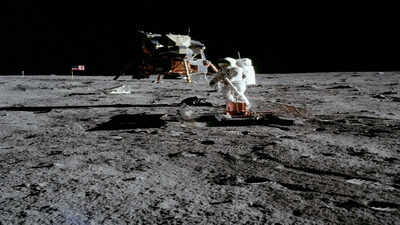
Few people chasing history go to government surplus auctions. They are typically used to empty warehouses of equipment and goods a public agency no longer needs, and that attracts bargain hunters who want to resell or strip parts and not find anything of enduring value. Gary George was one of those regular visitors, an engineering student at Lamar University who would periodically drop by liquidation sales near NASA’s Johnson Space Centre in Houston during his internship there in the mid-1970s. What he came away with on a June afternoon in 1976 included something whose importance would not become clear for decades.George paid $217.77 for a single quantity of around 1,150 reels of magnetic tape that had belonged to the space agency. They were mostly standard broadcast tapes that he would sell to local TV stations and then erase and reuse. But hidden amid the crates were three reels that bore a label that meant little to him at the time: Apollo 11 EVA, July 20, 1969. To get a sense of why those three reels were so important, it helps to look at how the original moonwalk footage really made it to TV screens throughout the world.Why original footage was so scarceAs the Apollo 11 astronauts set foot on the moon’s surface, cameras transmitted live video to three tracking stations that translated the signal for distribution to networks worldwide. NASA documentation explains that the television signal reaching Houston had already been converted from the astronauts’ slow-scan format, causing the broadcast image to lose significant sharpness compared with the raw feed seen at the tracking stations. And it was this Houston recording, not the widely repeated TV copy, that was packaged with George’s purchases, leaving no one at the agency the wiser. For years George didn’t know what he possessed, and the cassettes almost ended up the same way as the rest of the lot.By coincidence preserved over 40 years His father saw the label on the three reels and said George should put them aside, not sell them or let a television station tape over them. George did keep them, but for more than forty years he barely thought about the tapes and never once had them played. The tapes attracted renewed attention in early 2008, when George learned that NASA was unsuccessfully searching for its original Apollo 11 EVA recordings ahead of the mission’s 40th anniversary. George subsequently had his tapes examined and digitised, revealing that they contained a contemporary copy of the Apollo 11 moonwalk broadcast with unusually high image quality. What followed converted a neglected box of leftover tape into one of the most talked about pieces of space memorabilia in recent memory.
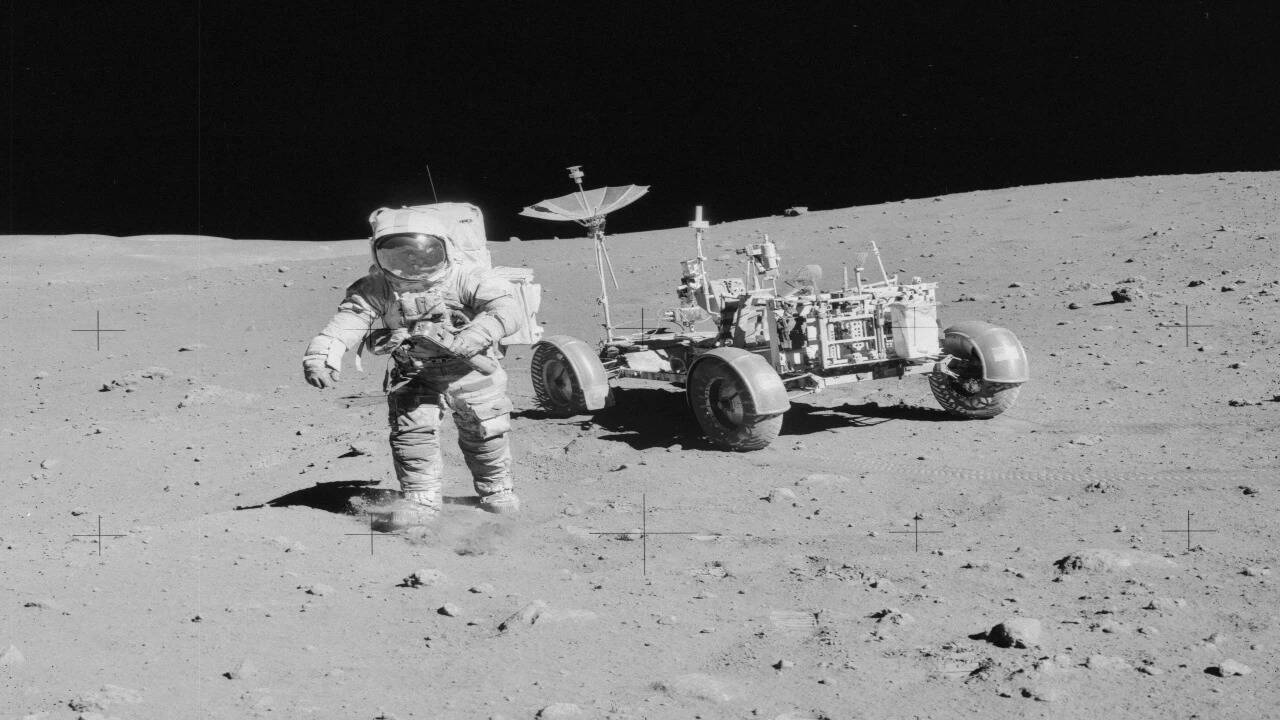
Apollo mission Commander Dave Scott kicking up dust near while walking away from the Lunar Rover. Credits – Wikimedia Commons
Anniversary record saleOn July 20, 2019, Sotheby’s auctioned the three reels in New York, a date chosen deliberately because it marked the 50th anniversary of Armstrong and Aldrin walking on the surface of the moon. Three bidders, online and on the phone, fought over the lot, which eventually sold for more than eight thousand times what George had spent for the whole haul of 1,150 reels in 1976. A later Sotheby’s press release, issued for a follow up sale later that year, reported the recordings had fetched $1.82 million in the previous auction, making them the highlight deal of that year’s Space Exploration sale. The winning bidder was never identified, which only added to the mystery surrounding the sale price compared with the original $217.77. George had originally handed over for the entire lot.The story is a rare reminder of how even the most diligent of institutional archives, such as NASA’s, can lose track of material that subsequently proves to be irreplaceable. It also demonstrates how little the value of an object can depend on its location, considering that one of the most important visual documents of the 20th century’s most famous triumph was hidden away for decades among a family’s belongings, mingling with reels that would otherwise have been erased and entirely lost. The survival of George’s tapes nevertheless preserved a rare contemporary record of the Apollo 11 moonwalk, offering a much clearer view of the broadcast than the degraded television copies seen by audiences in 1969.