









For eight decades Japan’s security posture was defined by three near-sacred rules: no meaningful use of military power, no arms exports, and minimal spending on defence.The constraints were not just policy. They were the scaffolding of a post‑war identity.Between the 1890s and 1945, Japanese imperial expansion brought occupation, mass violence, forced labor, sexual slavery (comfort women), and wartime atrocities across East and Southeast Asia. Those experiences are embedded in national histories, education, museums and family memories across China, Korea, the Philippines and elsewhere.
After the end of World War 2, Japan’s adoption of pacifism was meant not only to limit Tokyo’s options but to reassure neighbours that imperial aggression would not recur.Post‑war institutions, apology diplomacy, and constraints on bases and weapons became part of a regional social contract.But over the last decade, Tokyo has steadily chipped away at these post‑war shackles.Defence budgets are rising, military capabilities are being rebuilt, weapon sales have resumed, a central spy agency is being built from scratch, and most shockingly Japan is no longer shying away from debating the role of nuclear weapons in the country’s defence.For China, this is more than a policy shift; it is a historical provocation that reopens the painful memory of imperial militarism.A technologically sophisticated US ally that once constrained itself is transforming into a military power with reach and influence across Asia and beyond.Beijing is seeing its strategic space shrinking as a ‘mortal enemy’ flexes its muscles once again.
Article 9: The fount of Japan’s post‑war pacifism
Article 9 of Japan’s US‑drafted 1947 constitution renounced war as a sovereign right and declared that “land, sea, and air forces, as well as other war potential, will never be maintained”. It was the legal and psychological anchor of Japan’s post‑war pacifism.Three pillars defined this security posture formulated by Prime Minister Shigeru Yoshida, which came to be known as the Yoshida Doctrine.First, an “exclusively defence‑oriented policy” that ruled out pre‑emptive strikes and limited Japan to responding after an attack. Second, a self‑imposed cap that held defence spending around 1% of GDP, symbolising restraint and signalling to neighbours, especially China and South Korea, that Japan rejected great‑power militarism. Third, strict bans on arms exports and overseas deployments.For decades, Tokyo navigated this apparent pacifism‑on‑paper through legal reinterpretation, arguing that a minimal “self‑defence” capability was compatible with Article 9, which led to the creation of the Self‑Defense Forces (SDF) in 1954 but kept them under tight constraints.
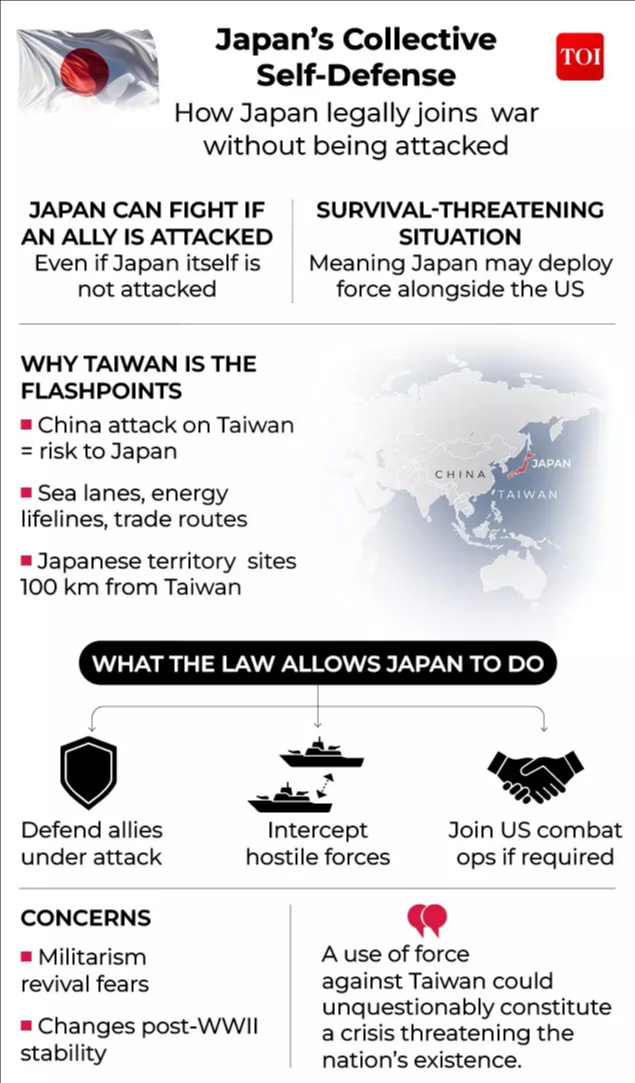
Japan’s collective self‑defence argument: Limited use of force to defend allies under attack, even if Japan itself was not directly hit.
This framework began to fray after the Cold War, and especially after the 1991 Gulf War, when Tokyo was criticised for “chequebook diplomacy” because it contributed money but not troops. Incremental steps followed: participation in UN peacekeeping (Cambodia in the 1990s), anti‑piracy operations off Somalia, and logistical support in the Indian Ocean after 9/11, each time stretching the interpretation of “self‑defence” and “non‑combat” roles.The real strategic break, however, came under PM Shinzo Abe, who championed the idea of “proactive contribution to peace” and pushed through a 2014 reinterpretation allowing “collective self‑defence” – limited use of force to defend allies under attack, even if Japan itself was not directly hit.In 2015, a package of security laws operationalised this shift, allowing the SDF to defend US assets, and in theory fight alongside allies beyond purely territorial defence.For China, this re‑engineering of Article 9’s meaning was not just a legal manoeuvre but a political signal that the constitutional brake on Japanese force projection was eroding and that Tokyo could participate in regional conflicts alongside the US, including in scenarios over Taiwan or the South China Sea.
Defence spending: Breaking the 1% glass ceiling
If reinterpretation of Article 9 changed the when and where Japan might use force, the recent spike in defence spending changed the how.In late 2022, Tokyo adopted a new National Security Strategy, National Defence Strategy and Defence Buildup Programme that together marked a decisive shift from “light” territorial defence to a more robust deterrence posture.Tokyo committed to double defence spending from around 1% to roughly 2% of GDP by 2027, which will likely place Japan among the world’s top three defence spenders.
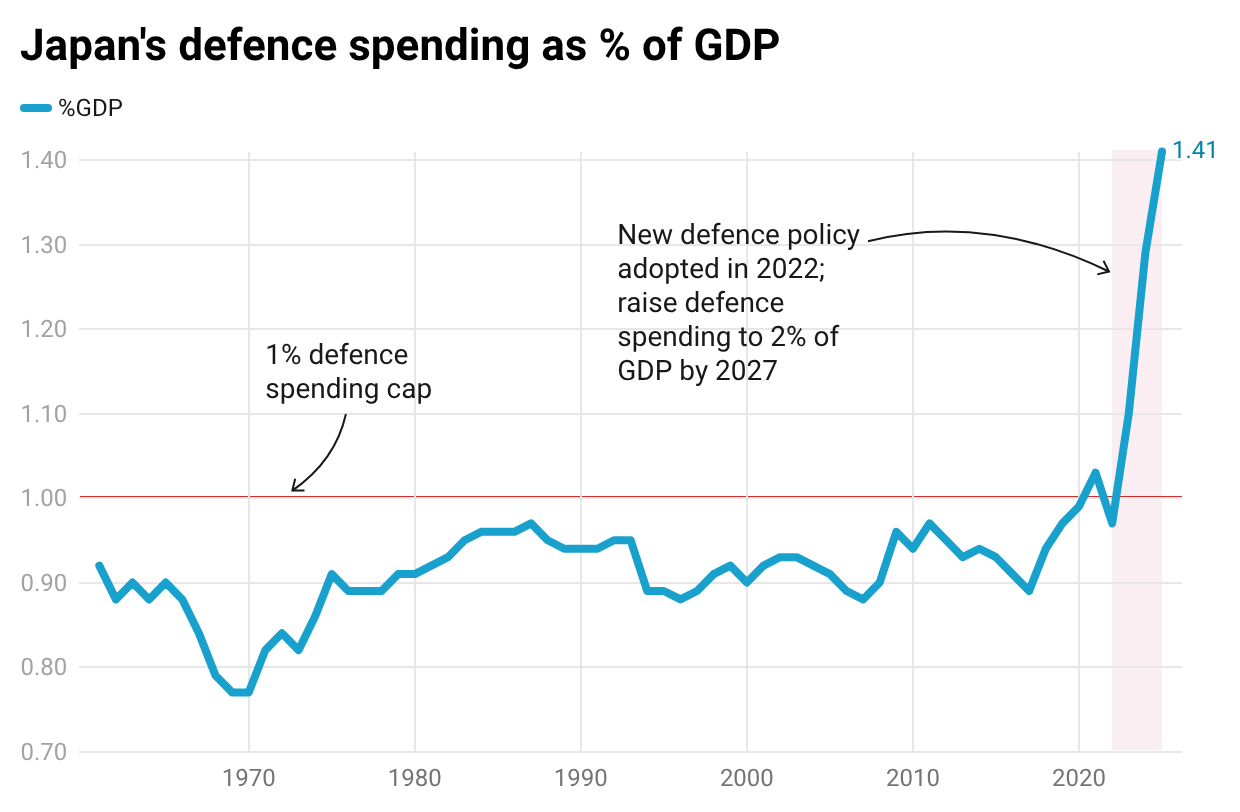
Tokyo committed to double defence spending from around 1% to roughly 2% of GDP by 2027
In December 2025, Prime Minister Sanae Takaichi’s cabinet approved a record $58 billion defence budget for 2026 — a 3.8% rise from the previous year and the 12th consecutive annual increase.The focus is not on mass conscript armies but on qualitative advantages. Priority areas include:
- Long‑range counter‑strike missiles capable of hitting bases in an adversary’s territory.
- Integrated air and missile defence against North Korean and, implicitly, Chinese missile arsenals.
- Space, cyber and electromagnetic warfare capabilities to protect Japanese command‑and‑control and disrupt an adversary’s.
- Strengthening the defence industrial base to sustain high‑end capabilities over time.
The counter‑strike element is particularly controversial domestically because it cuts against decades of insistence that Japan would never possess “offensive” power.
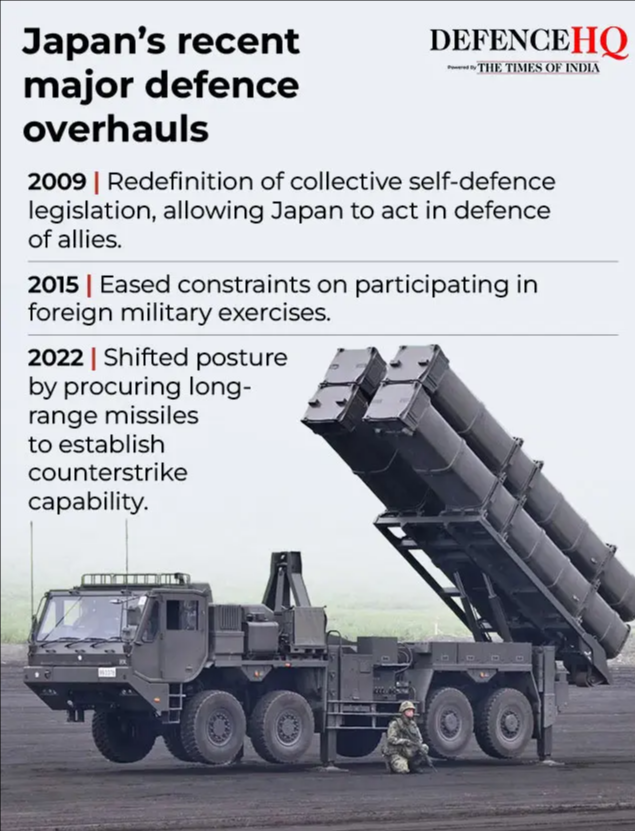
Japan’s defence posture
The government’s argument is that when potential adversaries possess large missile inventories and advanced ISR (intelligence, surveillance, reconnaissance) networks, purely passive defence is no longer credible and that the ability to hold hostile launch sites at risk is itself defensive in character.Beijing sees a different picture.Chinese strategists interpret Japan’s turn to long‑range precision fires and integrated US‑Japan operational planning as a step toward “interoperable” power projection that could be used in any future Taiwan contingency.A Japan able to strike missile bases on the Chinese mainland in coordination with the US would complicate China’s war‑planning, raise the costs of coercion around the Senkaku/Diaoyu Islands, and erode the People’s Liberation Army’s (PLA’s) regional freedom of action.
Breaking the arms export taboo
If Article 9 symbolised post‑war pacifism, Japan’s near‑total ban on arms exports gave it concrete form.In 1967, the government introduced the “Three Principles on Arms Exports”, prohibiting exports to communist states, countries under UN arms embargoes and states involved in or likely to be involved in conflict.In 1976, Tokyo went further, announcing that it would “refrain from promoting” arms exports to any destination, effectively turning Japan into a de facto non‑exporter of weapons even as its civilian industries – shipbuilding, electronics, aerospace – became world‑class.The rationale was twofold: to prevent Japanese weapons from fuelling conflicts abroad and to reinforce the country’s self‑image as a “peace‑loving nation”.The system allowed for important exceptions – notably, transfers of military technology to the US – but kept Japan absent from the global arms market for decades.Facing rising regional threats and mounting costs for high‑end platforms, Tokyo began to dismantle this regime.In 2014, the Abe government replaced the old rules with the “Three Principles on Transfer of Defence Equipment and Technology”, allowing exports under certain conditions, particularly to close partners and for joint development.Yet in practice, political caution and bureaucratic hurdles meant that only a handful of non‑lethal systems, such as maritime patrol equipment and radars, actually moved.The real break came after 2023, as a series of decisions opened the door to more substantive deals, allowing transfer of jointly developed systems, including next‑generation fighter components.This year, Tokyo lifted its long‑standing ban on exporting lethal weapons.Lethal exports are now allowed, case‑by‑case, to 17 countries that have defence equipment and technology transfer agreements with Japan, including India.From Beijing’s perspective, this is deeply unsettling.China’s media and officials portray the lifting of the lethal‑arms export ban as “reckless” and point to Japan “abandoning” its pacifist identity, warning that Japanese weapons could again find their way into conflict zones across Asia.Strategically, a Japan that can equip partners – whether Southeast Asian states worried about Chinese maritime assertiveness or European allies bolstering their Indo‑Pacific presence – contributes to a more coordinated balancing coalition that complicates China’s rise.
Building an intelligence state
If there is one domain where Japan lagged long after other major powers, it is intelligence. The country relied heavily on US information, lacked a centralised strategic‑intelligence body like the CIA or MI6, and often struggled to integrate domestic law‑enforcement, security and diplomatic information into a coherent national picture.This gap became increasingly glaring as cyber threats, grey‑zone operations in the East China Sea, and missile tests by North Korea multiplied.China and Russia have targeted Japanese ministries, defence firms and critical infrastructure for technology theft and intelligence. In Russia’s case, sanctions‑busting networks exploiting Japanese companies to obtain components for missiles and drones became a wake‑up call that Japan was a weak link in the Western sanctions regime.
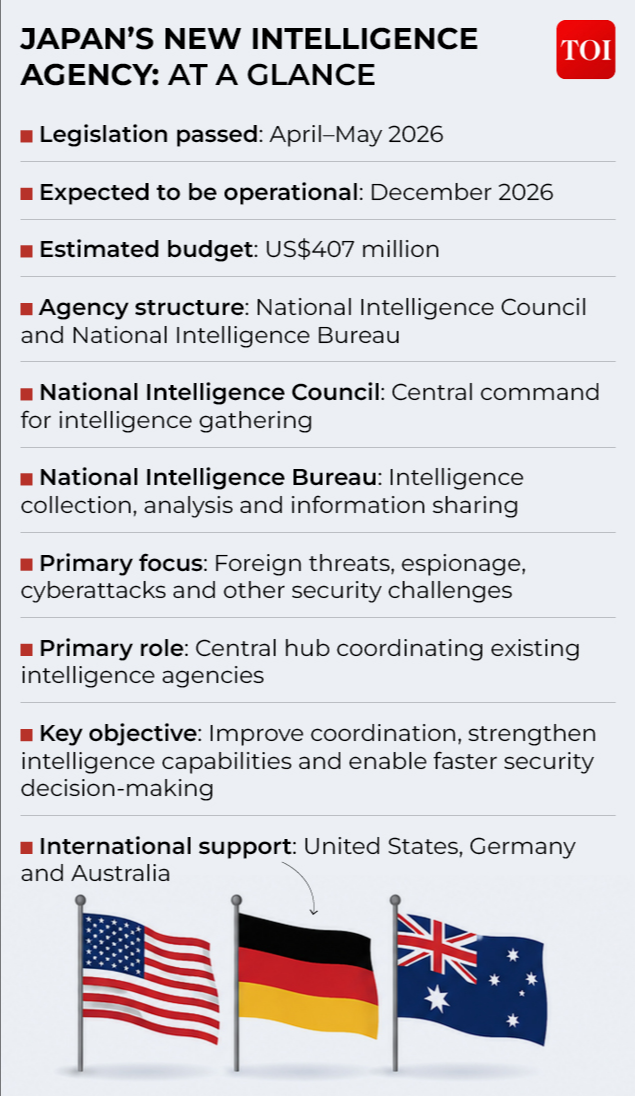
Over the past decade, Tokyo has moved quietly but steadily to strengthen its intelligence infrastructure
Over the past decade, Tokyo has moved quietly but steadily to strengthen its intelligence infrastructure, including the creation of a National Security Council and a National Security Secretariat in the Prime Minister’s Office.The most dramatic step came in May this year, when the Takaichi-led Japanese government passed a law establishing a National Intelligence Council chaired by the PM and a National Intelligence Bureau as its operational arm, consolidating fragmented agencies under more unified command.Chinese officials have been quick to criticise this move.After the law’s passage, Beijing publicly expressed concern, recalling that Japanese intelligence agencies historically “helped lay the groundwork for Japan’s militarism and its wars of aggression”. The warning folded two messages into one: a historical reminder aimed at regional audiences still scarred by Imperial Japan’s occupation, and a current‑day anxiety that a more capable Japanese intelligence apparatus, plugged into US and possibly ‘Five Eyes’ networks, will be used to monitor and counter Chinese activities across the region.
Going nuclear
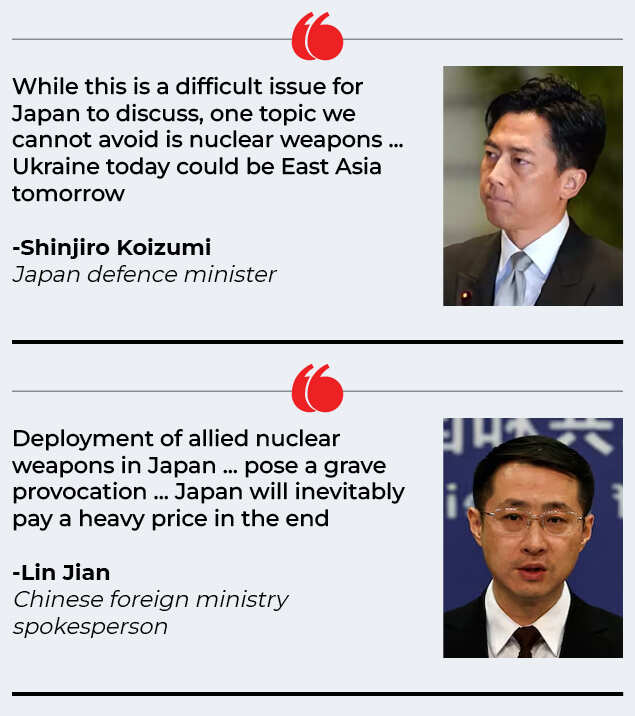
Perhaps the most shocking shift in Japan’s policy has been its attitude towards nuclear weapons.On July 19 this year, defence minister Shinjiro Koizumi urged Japan to more openly debate the role of nuclear weapons in the country’s defence.The remarks came as the government weighed tweaks to key documents outlining Japan’s security policy — including a possible revision of the ‘Three Non-Nuclear Principles’, a pledge formulated in 1967 to not produce, possess or host nuclear weapon.Senior government officials have traditionally shied away from public remarks on nuclear arms-related issues, as Japan — the sole country to have been attacked with the devastating weapons — retains strong sensitivities more than 80 years after atomic bombs were dropped on Hiroshima and Nagasaki.Japan is also a signatory of the Non-Proliferation of Nuclear Weapons Treaty and public sentiment is highly against nuclear weapons.
Perhaps the most shocking shift in Japan’s policy has been its attitude towards nuclear weapons.
According to an April poll by the Asahi Shimbun daily, 75% of those surveyed said the three non-nuclear principles should be maintained, while 21% said they should be revised.Still, talks of allowing US nuclear weapons to be brought into Japan have grown after Takaichi came to power in late 2025.The shift has rung alarm bells in China and illicited an extremely sharp response.Last week, Chinese foreign ministry spokesperson Lin Jian said that if the “Japanese ruling authorities keep misjudging the situation on nuclear issues and persist in revising the Three Non-Nuclear Principles to allow the deployment of allied nuclear weapons in Japan, such moves will not only pose a grave provocation to the post-WWII order and the global nuclear non-proliferation regime, but also run counter to Japan’s own peaceful pledges, and Japan will inevitably pay a heavy price in the end”.
Why China is worried
China’s unease with Japan’s defence shift runs on three linked levels: history, hard power and alliances.First, history remains an active instrument in Chinese domestic and foreign policy.The memory of Japan’s wartime atrocities underpins the legitimacy of the Communist Party’s claim to have “saved” the nation and is mobilised whenever Tokyo appears to be shedding restraints. Any move by Japan can be reframed in Beijing’s discourse as a step back toward imperial militarism, even when the stated purpose is deterrence.That framing also finds sympathy in parts of South Korea and Southeast Asia, complicating Japan’s diplomacy.Second, at the level of hard power, China sees Japan’s trajectory as part of a broader, unfavourable shift in the regional balance.Japan’s 2% defence spending target, counter‑strike capabilities, modernised SDF and stronger defence industrial base collectively represent a significant capability boost on China’s eastern flank. This limits the PLA’s ability to concentrate forces against Taiwan or in the South China Sea without worrying about a more muscular Japanese response.Moreover, potential Japanese arms exports to Southeast Asia – patrol vessels, radar systems or coastal defence missiles – further reduces China’s leverage over smaller neighbours.Third, alliance dynamics amplify these concerns.Japan’s reforms come with deeper integration into US‑led partnerships — trilateral work with the US and South Korea, closer ties with Australia and the UK, and other minilateral groupings around the Indo-Pacific.As Tokyo becomes more capable, US contingency plans can weave Japanese assets into maritime surveillance, anti‑submarine warfare, missile defence and logistics.For China, this means that any crisis in the region is less likely to be a bilateral contest and more likely to involve a coalition with Japanese power at its core.Intelligence ties intensify this worry. A centralised Japanese intelligence agency linked with US and allied services would improve early warning, attribution and coordinated responses to grey‑zone tactics — cyberattacks, disinformation or maritime harassment — often used by Beijing to operate below the threshold of open war.
Domestic constraints and regional signalling
Japan’s transformation is not unfettered.Powerful domestic and legal limits still shape how far and how fast Tokyo can go.Constitutional revision – formally amending Article 9 rather than reinterpreting it – still faces high political and public hurdles, and security policy debates remain polarised between hawks and defenders of pacifism.Even as the government raises defence spending, it must contend with demographic stresses, fiscal pressures and resistance to diverting resources from social welfare.On arms exports, public opinion is cautious, and bureaucratic procedures are complex, meaning that the headline “lifting of lethal arms‑export ban” will translate into a slow, case‑by‑case operational reality.On intelligence, civil‑liberties advocates and parts of the media remain wary of surveillance powers, drawing explicit parallels with wartime secret police, which will shape how intrusive the new apparatus can become.Regionally, Tokyo is acutely aware that its security shift needs careful signalling.Successive Japanese governments have paired defence reforms with diplomatic outreach. The message, especially to Southeast Asia and India, is that a stronger Japan is a provider, not a disruptor, of security – one that can share technology, build capacity and uphold rules in the maritime commons.China contests this narrative, framing Japanese moves as part of a US‑engineered containment strategy and warning that they risk triggering an arms race in Asia.
The big picture
Japan’s journey from strict pacifism to a more conventional defence posture is far from complete, but its direction is clear: more spending, more capabilities, more exports and more intelligence. Each of these moves erode post‑war taboos rooted in the trauma of 1945, and each is being justified by reference to contemporary threats.For 80 years, Japan’s security architecture was designed to prevent it ever again being a source of instability. The irony of this moment is that Japan is tearing down many of those self‑imposed walls in the name of preserving regional stability in the face of China’s rise, Russia’s aggression and North Korea’s nuclear brinkmanship.From Beijing’s perspective, a once‑reluctant, constrained neighbour is turning into a full‑fledged strategic competitor, with the legal mandate, hardware, industrial base and intelligence apparatus to matter in any Indo‑Pacific contingency.For now, the story is one of parallel, mutually reinforcing anxieties.Japan looks at China and sees an increasingly capable, coercive neighbour whose military spending dwarfs its own and whose intentions it questions.China looks at Japan and sees an ally of the US steadily casting off 80-year-old restraints.Between those perceptions lies the risk that each move by Tokyo, intended as defensive and deterrent, will be read in Beijing as confirmation that the ghosts of the past are returning, fuelling the very insecurity Japan seeks to manage.