







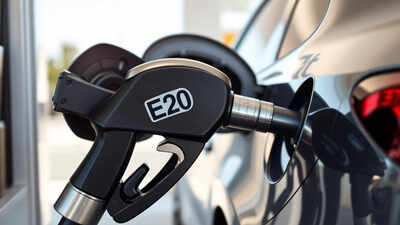
NEW DELHI: A report by Automotive Research Association of India (ARAI), which recommended rollout of E20, had concluded that using the fuel in E10-compliant vehicles showed deterioration in rubber parts of fuel-system components, such as hoses, gaskets, seals and O-rings.The study, not yet made public, has been a reference point for govt and vehicle makers. It had said these parts “may need replacement”. On all vehicles tested, E20 was found to have no adverse impact on metallic components, and emissions with E20 were within legislative limits on E10-compatible vehicles.The study’s findings on the impact of E20 fuel on E10 vehicles also stated that during “4-wheeler engine durability test”, the performance of one BS-IV engine was acceptable with E20, but “issue was observed with BS-VI turbo charged engine after 265 hours of durability”.The part of the study that dealt with “engine durability” stated that two four-wheeler vehicle manufacturers, or OEMs, carried out the test. While for one OEM, no issue was observed for engine durability after 400 hours of testing and performance was acceptable with E20 fuel, in the case of the other OEM, “thermomechanical failure of exhaust valve was observed in the engine(s) tested cumulatively for 809 hours”.People aware of the findings said there could be other reasons for thermomechanical failure of the exhaust valve in the case of the second OEM. However, experts involved in vehicle testing said that generally engine durability tests are carried out for 2,000 hours.As per the report, engine durability tests conducted by three two-wheeler manufacturers found no issue, and the “performance is acceptable with E20 fuel”.It had also concluded that fuel consumption of vehicles with E20 increased 2-6% compared to E10. However, the percentage increase in fuel consumption varies vehicle to vehicle.