








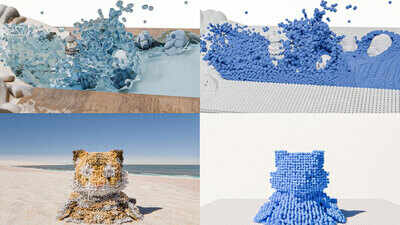
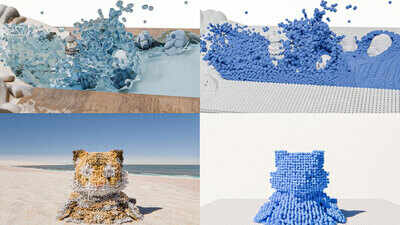
Researchers have developed an artificial intelligence (AI) model that can simulate the behaviour of different materials, ranging from sliding sand and deformable objects to changing protein structures. Called WorldParticle, the system represents materials as tiny particles and predicts how they move, one step at a time, using a single AI architecture.The model was developed by researchers from the Massachusetts Institute of Technology (MIT), the University of British Columbia (UBC) and several other institutions. It learns the underlying dynamics of physical systems rather than relying on separately programmed equations for each material. The research, which will be presented at the ACM SIGGRAPH Conference and Exhibition on Computer Graphics and Interactive Techniques in Asia, was reported by MIT News.
How does WorldParticle simulate different materials?
WorldParticle breaks an object into thousands or millions of tiny, three-dimensional particles. It tracks their positions, velocities and physical properties to simulate how the material changes over time.Typically, scientists use governing equations to describe how a particular material behaves. They then convert these equations into formulas that numerical solvers can process. This process has to be repeated for different materials and physical phenomena.Instead, the researchers designed a neural network that learns to solve governing equations in general, eliminating the need to develop a separate model and solver for every system.The network takes the three-dimensional positions and physical properties of particles as inputs and predicts their positions and properties in the next simulation step. It also accounts for external forces affecting the physical system before correcting its predictions.Peter Yichen Chen, a former MIT postdoctoral researcher who is now an assistant professor at UBC and a co-corresponding author of the research, compared the architecture to ChatGPT. While ChatGPT predicts one word at a time, WorldParticle predicts how particles move, one step at a time.
From collapsing sand to changing proteins: What did the researchers find?
The researchers demonstrated WorldParticle across six different physical phenomena, including deformable objects, granular materials and proteins. According to MIT News, the model achieved higher accuracy than numerical simulation methods in these demonstrations.In one example, WorldParticle captured how a granular object collapses into a pile. Some baseline methods, in comparison, left sand particles floating in the air.The system also modelled how protein structures change over time approximately 100 times faster than numerical simulators, according to Minghao Guo, an MIT postdoctoral researcher and co-corresponding author.
How could the AI model be used?
The researchers believe WorldParticle could be applied to several areas, including soft robot manipulation, RNA evolution and astrophysical phenomena such as the merging of galaxies.The system can adapt to materials, forces and environmental conditions that it has not encountered during training. This could help scientists study physical processes without developing a separate simulator for every material or phenomenon.
Researchers aim to develop a general-purpose simulation system
The team plans to adapt WorldParticle to simulate additional physical systems and build on the work towards a full, general-purpose simulation pipeline for scientific discovery.The researchers hope the approach will help scientists discover new materials and investigate physical processes that existing simulation methods cannot effectively study.