









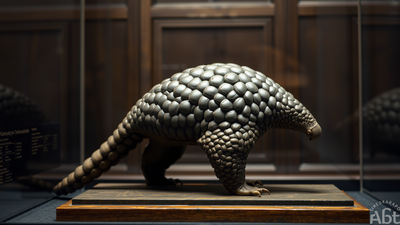
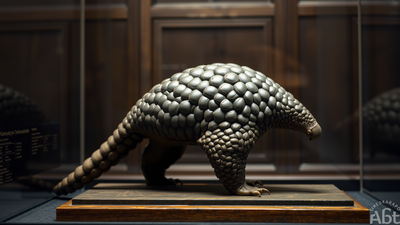
A nearly 190-year-old pangolin specimen sitting on a museum shelf in London has helped scientists confirm the existence of a distinct pangolin species living in Nepal and northern India. Researchers used DNA extracted from the historic specimen, originally collected in 1836, to settle a long-standing taxonomic debate over whether the Himalayan pangolin was simply a subspecies of the Chinese pangolin or a separate species altogether. The findings, published in the journal Communications Biology, confirm that the animal should be classified as Manis aurita, restoring a name first given to it nearly two centuries ago. Pangolins are already the most heavily trafficked mammals in the world, and the discovery is expected to help shape conservation and anti-poaching efforts across the region.
How the 190-year-old museum specimen solved the pangolin mystery
The breakthrough came from a specimen originally collected by the naturalist Brian Houghton Hodgson in Nepal in 1836 and later housed at the Natural History Museum in London. According to thestudy published in Communications Biology, researchers successfully sequenced DNA directly from this historic type specimen and compared it against genetic material gathered from living pangolins across Nepal and northern India. The results showed a clear match, confirming that modern Himalayan pangolins belonged to the same lineage that Hodgson had described almost two centuries earlier.This mattered because a separate species, Manis indoburmanica, had been proposed in a 2025 paper based on mitochondrial DNA from confiscated pangolin scales. Since scientific naming rules give priority to whichever valid name was published first, confirming that the historic specimen matched the modern animals meant the earlier name, aurita, took precedence, and indoburmanica became what scientists call a junior synonym, a name no longer used once an earlier valid name is established for the same species.
Why researchers needed both genomic and morphological evidence
The Field Museum in Chicago, whose researchers co-led the study, explained that the team combined genomic analysis with detailed physical comparisons rather than relying on DNA alone. Scientists examined 44 skulls and 26 skins from museum collections to compare body measurements, ear shape, tail length and scale patterns between the Himalayan pangolin and the Chinese pangolin.The physical differences turned out to be consistent, if subtle. The Himalayan pangolin is generally larger, with a longer tail and noticeably smaller ears than its Chinese counterpart, a detail reflected in the species name aurita, which refers to its distinctive ears. Genomic analysis in the study also indicated that the two lineages diverged roughly 1.8 million years ago and have remained largely isolated from each other since, with only minimal interbreeding between them.
What the discovery means for pangolin conservation
Pangolins are poached heavily for their scales, which are used in traditional medicine despite being made of keratin, the same material found in human fingernails and hair. Because traffickers and enforcement agencies typically encounter only scales rather than whole animals, correctly identifying which species a seized scale sample belongs to has been a persistent challenge for wildlife law enforcement.Researchers involved in the study said the revised classification gives conservationists a clearer picture of where each species actually lives, since the Himalayan pangolin and Chinese pangolin occupy separate, non overlapping ranges. This is expected to improve how rescued or confiscated pangolins are reintroduced into the wild, since releasing the wrong species into an unfamiliar region could do more harm than good. Knowing the precise boundaries of each species range also allows investigators to trace seized scales back to the specific geographic areas where poaching is taking place, making it easier to target enforcement efforts.
Why old museum collections still matter for modern science
The study’s authors pointed out that the discovery would not have been possible without museum collections that have preserved animal specimens for over a century. Many natural history museums around the world hold pangolin specimens collected decades or even centuries ago, and this research shows that such collections can still answer pressing scientific questions long after they were first gathered.For a group of animals as elusive and rare as pangolins, researchers said access to museum specimens allows a far more complete picture of a species than relying on live animals alone, since pangolins are notoriously difficult to study in the wild. The confirmation of Manis aurita as a distinct species stands as a reminder that centuries-old scientific collections continue to carry real conservation value, long after the specimens themselves were first catalogued and shelved away.