








In 1991, American businessman Douglas Tompkins, who had co-founded the outdoor clothing companies The North Face and Esprit, bought a semi-abandoned plot of land in the Renihue River Valley in southern Chile, drawn by the region’s ancient, untouched temperate rainforest. What began as a personal effort to protect one threatened valley grew, over the following decades, into one of the largest private conservation projects in history. Tompkins and his foundation went on to acquire vast tracts of surrounding wilderness, eventually donating hundreds of thousands of acres back to the Chilean state. That land, combined with existing government-held territory, was formally established in 2018 as Pumalin Douglas Tompkins National Park, a protected area covering 994,332 acres, larger than Yosemite National Park in the United States.
How Douglas Tompkins began buying land in Patagonia
According to Tompkins Conservation, the organisation founded by Tompkins to carry out this work, his interest in the region grew out of years spent visiting Patagonia as a mountaineer and outdoorsman since the early 1960s. After purchasing his initial parcel of land in the Renihue Valley in 1991, Tompkins established the Conservation Land Trust the following year, in 1992, specifically to fund and organise further land purchases across the region for permanent conservation.Much of the land acquired through this process had been left in the hands of absentee owners who had bought it decades earlier during Chile’s logging boom in the 1920s, but rarely visited or developed it further. This meant Tompkins was often purchasing wilderness that had already gone largely undisturbed for decades, giving conservationists a rare opportunity to protect ecosystems that had escaped large-scale commercial exploitation almost by accident.
Why the alerce forests of Pumalin mattered so much
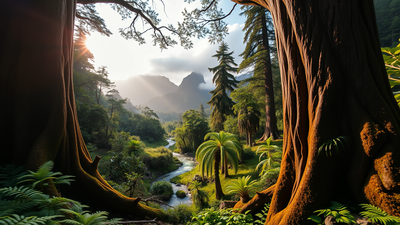
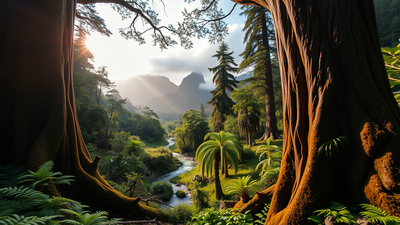
Central to Tompkins’s motivation was the protection of Chile’s alerce forests, home to some of the oldest living trees on the planet. According to Tompkins Conservation, Pumalin protects roughly 25 per cent of the world’s remaining old-growth alerce trees, a species that can live for more than 3,000 years and is closely related to the giant sequoia found in North America. The park’s temperate rainforest, fjords, glaciers and volcanic peaks also provide habitat for species found nowhere else, including the pudu, one of the world’s smallest deer species, and the monito del monte, Chile’s only native marsupial.Beyond its role in protecting individual species, the park’s forests also store a substantial amount of carbon, with Tompkins Conservation estimating the park’s total carbon storage at roughly 229.3 million metric tons, underscoring the broader climate significance of preserving old-growth temperate rainforest at this scale.
How Pumalin eventually became a Chilean national park
The process of converting Tompkins’s private conservation project into an official national park unfolded gradually over more than two decades. The land was first designated a nature sanctuary in 2005, giving it a degree of formal protection while still operating as Chile’s largest privately held nature reserve, open to the public with its own trails, campgrounds and visitor facilities.The full transformation into a national park came through a landmark 2017 agreement between the Chilean government and Tompkins Conservation. According to Yale School of the Environment, Kristine Tompkins, who continued the conservation work after her husband’s death in 2015, donated close to 1 million acres of land to the Chilean government that year, forming part of an agreement that ultimately established Pumalin Douglas Tompkins National Park in 2018, alongside several other new and expanded national parks across Chilean Patagonia.
Why this became the largest private land donation in history
The scale of the donation involved in creating Pumalin, combined with several related park projects across the region, is widely described as the largest private land donation in history. Roughly 725,000 acres of the park’s total 994,332 acres came directly from Tompkins Conservation’s donation, with the remainder made up of land the Chilean government already owned or reclassified from existing national reserves.This single agreement was part of a far larger conservation legacy built by Doug and Kristine Tompkins over more than two decades, during which their organisations acquired more than 2 million acres of land across Chile and Argentina for permanent protection, eventually contributing to the creation or expansion of multiple national parks across Patagonia.
What Pumalin represents today
Named in honour of its founder following a formal decree signed by Chilean president Michelle Bachelet and Kristine Tompkins, Pumalin Douglas Tompkins National Park now stands as one of the clearest examples of what large-scale private conservation philanthropy can achieve when eventually handed over to public stewardship. Located along Chile’s scenic Carretera Austral, the park remains open to visitors, offering an extensive network of trails, campgrounds and an information centre built around the same primaeval rainforest that first drew Tompkins to the region more than three decades ago.What started as one man’s decision to buy a run-down piece of land in a remote Chilean valley eventually reshaped conservation policy across an entire region, helping position Chilean Patagonia, now home to the vast majority of the country’s protected land, as an internationally recognised model for how private wealth and public partnership can work together to preserve some of the world’s last untouched wilderness.