









For decades, a mysterious deep-sea shark caught off the Kerala coast was believed to belong to a species found in the Atlantic Ocean. Its appearance seemed to support that identification, and it continued to be recorded under the same scientific name. But when Indian researchers examined the shark more closely and analysed its DNA, they uncovered something unexpected: it was a distinct species that had remained hidden in plain sight.The discovery of Echinorhinus roinee, popularly known as the Indian Bramble Shark, has added a new chapter to India’s marine biodiversity research. It also highlights how much scientists are yet to understand about life beneath the Indian Ocean.
A shark mistaken for an Atlantic species
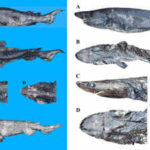
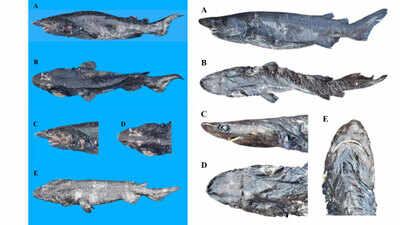
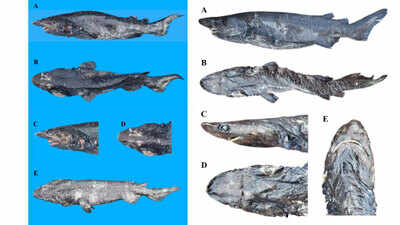
The specimens were collected at Sakthikulangara Fishing Harbour in Kollam, Kerala, after being brought ashore as accidental catches by deep-sea shrimp trawlers.Researchers from the Zoological Survey of India (ZSI) and ICAR-Central Marine Fisheries Research Institute (CMFRI) investigated the specimens and found that they did not match the Atlantic bramble shark, as previously believed.The Indian Bramble Shark can grow up to three metres and inhabits continental slope waters at depths of approximately 350–450 metres. Its dark brown to almost black body is covered with prominent thorn-like skin structures, giving it a distinctive appearance.
How DNA solved the mystery
The breakthrough came through a combination of physical examination and genetic analysis.Scientists studied the shark’s body measurements and distinctive features before examining its mitochondrial DNA, which helps researchers understand genetic relationships between organisms.The results confirmed that the shark belongs to a separate Indian Ocean genetic lineage. It is genetically distinct from the Atlantic bramble shark (Echinorhinus brucus) and the Pacific prickly shark (Echinorhinus cookei).Genetically similar records from Oman, Sri Lanka and Thailand also suggest that its distribution may extend beyond Indian waters.
Why identifying a new shark species matters
The discovery is important for more than adding another name to the list of marine species.Deep-sea sharks are frequently caught accidentally during commercial fishing operations. When different species are incorrectly identified as one, fisheries records can become misleading.Accurate identification helps scientists understand where a species lives, how frequently it is caught and whether its population faces conservation threats.Deep-sea sharks can also be particularly vulnerable to fishing pressure because many have slow growth rates and relatively low reproductive potential. Recognising the Indian Bramble Shark as a separate species could therefore support better monitoring and future conservation assessments.
A discovery with a personal connection
The scientific name roinee carries a personal significance. It honours Roinee, the daughter of Dr Dhriti Banerjee, Director of the Zoological Survey of India.The research findings were published in the Records of the Zoological Survey of India, Volume 126, Issue 1S (2026). The research team included scientists from ZSI and ICAR-CMFRI, with financial support from the Ministry of Earth Sciences under India’s Deep Ocean Mission.The type specimens have been preserved in the National Zoological Collections at ZSI’s Marine Biology Regional Centre in Chennai.
India’s deep sea still holds unanswered questions
The Indian Bramble Shark discovery is a reminder that the ocean remains one of the least explored environments on Earth. Even species regularly brought to fishing harbours can carry scientific secrets that go unnoticed for decades.With genetic research, marine exploration and biodiversity documentation advancing, India’s deep waters may reveal many more surprises.What scientists once considered an Atlantic visitor has now emerged as a distinct Indian Ocean species, proving that sometimes the biggest discoveries begin with a familiar-looking specimen and one unanswered question.