












On an August morning in 2025, a research vessel in the Gulf of Maine released 16,500 gallons of sodium hydroxide (lye) into the ocean while a plume of bright pink dye spread across the water’s surface. To onlookers, the vivid pink patch looked alarming. But the colour was intentional. The dye allowed scientists to track the movement of the treated seawater during what became the first federally permitted open-water ocean alkalinity enhancement (OAE) experiment in the United States.The trial, led by researchers from the Woods Hole Oceanographic Institution (WHOI) as part of the LOC-NESS (Locking Ocean Carbon in the Northeast Shelf and Slope) project, was designed to answer a critical question: could carefully increasing the ocean’s alkalinity help it absorb more carbon dioxide from the atmosphere and counter the growing threat of ocean acidification? Scientists said the experiment was designed to gather real-world data on how the strategy behaves outside the laboratory.How adding lye could help the ocean absorb more carbonAbout one-fourth of the world’s carbon dioxide emissions are taken up by the oceans, which helps slow down climate change. But as carbon dioxide levels in the water increase, the water becomes more acidic, and this hinders the formation of calcium carbonate shells in organisms like oysters, clams, corals, and plankton. Ocean alkalinity enhancement could one day become part of the climate solution, but much more information is needed before it can be deployed commercially. In the Gulf of Maine test, scientists released diluted sodium hydroxide gradually into the surface waters. Sodium hydroxide combines with the carbon dioxide that is already dissolved in water to form bicarbonate ions, which are the most prevalent and stable form of carbon in seawater.The bright pink rhodamine dye released alongside the sodium hydroxide served as a tracer, enabling researchers aboard a second vessel to monitor how the treated water mixed with surrounding seawater. Scientists continuously measured pH, alkalinity and other chemical properties throughout the six-hour release. The scientific foundation for ocean alkalinity enhancement is supported by research published in Nature Climate Change, which concluded that increasing ocean alkalinity could become an important carbon dioxide removal strategy if environmental impacts, verification methods and large-scale deployment challenges are carefully addressed.Why did scientists take the experiment into the open ocean?Until now, most ocean alkalinity enhancement research had been confined to computer models, laboratory studies and small coastal experiments. The Gulf of Maine trial represented an important step because it allowed researchers to observe how alkalinity enhancement behaves under realistic ocean conditions, where tides, currents and marine ecosystems are far more complex. The project underwent years of planning before receiving approval from the U.S. Environmental Protection Agency. Researchers also worked closely with fishermen, environmental organisations, regulators and local communities to explain the project’s objectives and safety measures. Throughout the experiment, observers monitored for marine mammals, while scientists tracked chemical changes in the water to ensure environmental limits were not exceeded.The Gulf of Maine provides an ideal testing ground because it supports economically important shellfish fisheries while also experiencing the effects of climate change, including changes in ocean chemistry. Research published in Scientific Reports found that although changes in ocean circulation have delayed severe acidification in the region, this natural buffering may not last indefinitely, increasing concern for future marine ecosystems and shellfish industries. Scientists emphasise that the experiment was never intended to demonstrate large-scale carbon removal. Instead, it was designed to validate computer models, improve monitoring techniques and determine whether ocean alkalinity enhancement can be measured accurately and safely under real-world conditions.
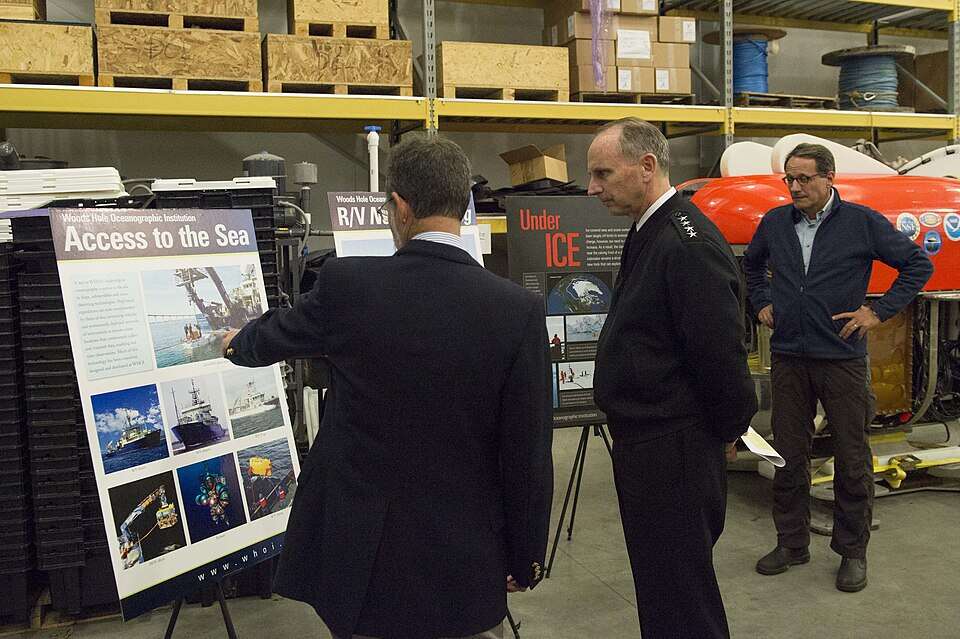
Chief of Naval Operations Adm. Jonathan Greenert tours the Woods Hole Oceanographic Institution (WHOI) where he spoke to WHOI leadership about global ocean observing, education opportunities at WHOI and unmanned autonomous vehicles developed by WHOI. Image Credits: Wikimedia Commons.
A promising idea with important questions still to answerOcean alkalinity enhancement has attracted growing interest because it could potentially remove carbon dioxide while simultaneously reducing ocean acidification. Unlike some carbon capture methods that require underground storage, much of the captured carbon remains dissolved in seawater as bicarbonate ions, where it can stay for thousands of years as part of the ocean’s natural carbon cycle.However, researchers caution that significant uncertainties remain. Scientists still need to understand how repeated alkalinity enhancement might affect marine ecosystems, ocean chemistry and coastal food webs if deployed on much larger scales. Questions also remain about costs, energy requirements and how to verify the amount of carbon permanently removed from the atmosphere. Many climate scientists say carbon removal technologies should complement, not replace, rapid cuts in greenhouse gas emissions.