










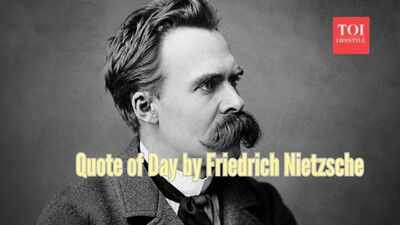
Friedrich Nietzsche’s impact is intense and can be felt even now. He is one of the most misunderstood, debated and influential philosophers. He challenged conventional morality, religion, culture and human nature and many of his ideas were controversial in his own time, but today Nietzsche is regarded as one of the greatest thinkers in Western philosophy.Friedrich Wilhelm Nietzsche was born on October 15, 1844 in Röcken, a small village in the then Kingdom of Prussia (now Germany). His father, a Lutheran pastor, died when Nietzsche was four years old. The loss was a heavy blow for the family and Nietzsche grew up in a home dominated by his mother, grandmother, two aunts and younger sister. He showed from an early age extraordinary intelligence and a love of literature, music and the classical languages. He went to the prestigious Schulpforta boarding school (one of the best educational institutions in Germany) where he was brilliant in Greek, Latin and philosophy.He then studied theology and classical philology at the University of Bonn, before transferring to the University of Leipzig. As a student he was captivated by the writings of philosopher Arthur Schopenhauer whose thoughts on human suffering influenced him greatly.A bright academic career:Nietzsche was recognised as brilliant remarkably early on. He became only 24 when he was appointed Professor of Classical Philology at the University of Basel in Switzerland, even before he had completed his doctorate—an unusual tribute to his remarkable scholarship. During these years he made the acquaintance of the famous composer Richard Wagner, whom he at first greatly admired. But the two men fell out when Nietzsche turned against Wagner’s nationalism and religious obsession.Nietzsche, at the age of 34, was forced to resign from his teaching post due to continuing ill health. He suffered from severe migraines, eye problems and long-term digestive disorders. Physically frail, this was to be the most productive period of his intellectual life. Now free from academic duties, he travelled across Switzerland, Italy and France, writing many of the books that would later make him famous.His revolutionary philosophy Nietzsche thought society believed things for the sake of it because they were passed down through the generations. His challenge to people was to question the accepted truths and think for themselves. Among his most famous ideas was the notion of the “Ubermensch” or “Overman” as introduced in his book, Thus Spoke Zarathustra. Contrary to popular belief, Nietzsche was not calling for racial superiority. Instead he saw a person who always tried to better himself, who created his own values and did not conform to what society expected.Another famous phrase associated with Nietzsche is “God is dead.” This was not a celebration of atheism but an observation that the coming of modern science, rationality and changing social values had eroded traditional religious authority in Europe. He also proposed the idea of the “will to power,” that humans are driven not just by survival or pleasure, but by a desire to grow, achieve, create and conquer challenges.In every piece of writing he wrote, Nietzsche urged people to confront the difficulties of life rather than run from them. He believed that suffering, setbacks and hardship often lay the foundation for personal growth and strength.His principal works Nietzsche wrote many influential books that are still studied all over the world. Among his more important works are-The Birth of Tragedy (1870), Human, All Too Human (1878), Thus Spake Zarathustra (1883–1885), Beyond Good and Evil, 1886, On the Genealogy of Morals (1887) and The Gay Science (1887). These books sold commercially during his lifetime although later they changed philosophy, psychology, literature and political thought.Nietzsche lived in Turin, Italy when in 1889 he had a complete mental break down. He was reported to have seen a horse being savagely whipped in the street and rushed to embrace the animal before collapsing. What exactly happened is disputed by historians, but it became symbolic of his mental collapse. It’s unclear what triggered his mental illness. Some have attributed it to syphilis; others have speculated it was due to a neurological disorder or genetic condition. Nietzsche never really recovered from the collapse. His mother cared for him until her death, and his sister Elisabeth took over. Nietzsche died at the age of 55 on 25 August 1900. It is ironic that the philosopher who struggled for recognition in his own lifetime should have become one of the most influential intellectual figures of the twentieth century.His impact on the worldNietzsche’s influence stretches far beyond philosophy. His insights into the human mind were admired by psychologist Carl Jung, and Sigmund Freud acknowledged Nietzsche’s deep understanding of unconscious motivation. Existentialist philosophers like Jean-Paul Sartre and Albert Camus took many of his ideas about freedom, meaning and responsibility and developed them. His writings also inspired such authors as Thomas Mann, Hermann Hesse and André Gide. His ideas are still influential among artists, film makers and musicians today.But there is also a wrong reading of Nietzsche’s legacy. After his death his sister Elisabeth, who controlled much of his unpublished writing, edited his work selectively, associating it with German nationalism. In the later period, the Nazi regime falsely claimed Nietzsche as one of its intellectual influences. The interpretation is overwhelmingly rejected by modern scholars. Nietzsche was a harsh critic of antisemitism, nationalism and blind obedience. His philosophy was based on individual freedom, not political ideology.Quote of the DayOne of the most iconic quotes of Friedrich Nietzsche is, “What makes unhappy marriages? It is not the lack of love but the absence of friendship.The quote is one of Nietzsche’s deepest insights into human relationships. When people think of successful marriages they often think of romance, attraction and passion. These feelings surely play an important role in bringing two people together. But, as Nietzsche argues, romantic love alone is not enough to sustain a partnership for life. Friendship is formed of elements that last longer than passion naturally changes. Friends trust each other. They respect each other’s individuality. They like being with each other even if there is no excitement or celebration. They laugh together, share in each other’s failures and truly care about each other’s growth.Romantic attraction alone can make relationships hard when life gets tough. All relationships are inevitably under pressure from financial problems, the responsibilities of parenthood, illness, career problems and old age. Often in such moments alone intense passion is not enough. Friendship offers a stability that romance can’t always provide. When spouses become true friends, they speak plainly, forgive mistakes more easily, and cheer each other’s victories without jealousy. They’re teammates, not rivals.” They accept each other’s flaws, and learn to appreciate each other’s strengths, rather than try to change each other.Nietzsche’s quote is a reminder that emotional intimacy often begins with friendship and not dramatic declarations of love. Often, the couples who create stronger relationships are the ones who stay curious about one another, keep sharing experiences, and genuinely enjoy each other’s company, not the ones that rely on romantic feelings alone.This observation is still remarkably relevant more than a century after Nietzsche’s death. In an age of often exaggerated romance, social media spectacles and great gestures, Nietzsche reminds us that the value of everyday companionship may be even greater. The strongest marriages are seldom perfect. They are instead partnerships where two people keep encouraging, challenging and supporting each other through the changing seasons of life.