








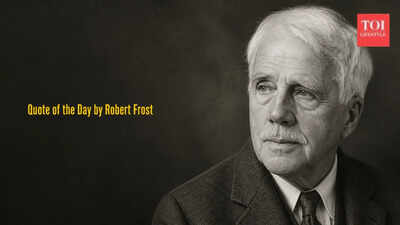
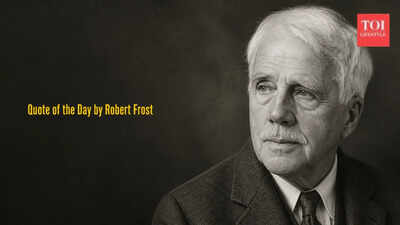
Robert Frost is one of the most beloved poets of America. He wrote poetry that people grew up reading, poetry that was impactful and relatable. Frost was known for his crystal clear descriptions of rural life, nature, human relationships and the complex nature of the human mind, as he converted seemingly simple moments into reflections on life, love, loneliness, choices and mortality. His poetry was easy to understand, but incredibly deep in meaning. He was one of the most widely read and respected poets of the 20th century.His works often included country roads, snowy woods, stone walls, farms and quiet talks. But these familiar images hid questions about human existence, individual freedom, responsibility and the choices that shape our lives. His poetry was timeless because it linked the natural world with human feelings.Early life and educationRobert Lee Frost was born in San Francisco, California, on March 26, 1874, the son of William Prescott Frost, Jr., a journalist and teacher, and Isabelle Moodie. His father named him after the famous Confederate General Robert E. Lee. Frost was raised in California for his early childhood, but his father died of tuberculosis in 1885 and his mother took him and his younger sister to Lawrence, Massachusetts to be closer to his father’s parents.The transition was difficult and the loss of his father hit him hard. Yet during his school years there was an early interest in literature and writing. He developed a taste for poetry and an interest in the works of classical and contemporary writers.Frost graduated from Lawrence High School in 1892, sharing the position of class poet with Elinor White, his future wife. He attended Dartmouth College and later Harvard University, but did not finish at either. He was more interested in pursuing his own intellectual and creative interests than in following a conventional academic path.In 1895 he married Elinor White and the two began a life together that would bring both happiness and considerable personal tragedy.The struggle before recognitionFrost did not achieve literary success overnight. For years he was a teacher, a farmer and a writer, trying to find his footing. He and his wife lived on a farm in Derry, New Hampshire, where he was close to rural life. These years became an important inspiration for his poetry. His experiences as a farmer gave him a close acquaintance with nature, with the changes of the seasons, with the work of the fields, and with the relation of man to his surroundings. Rather than romanticising rural life, Frost often depicted its difficulties, isolation and emotional complexity.Disillusioned by the lack of recognition in America, Frost moved in 1912 with his family to England. This choice was important for his literary career. His first book of poems, A Boy’s Will, was favourably received when it appeared in 1913. His second collection, North of Boston, published in 1914, made him known as an important new poetic voice.It included some of his best known poems, such as Mending Wall and After Apple-Picking. In 1915 Frost came back to the United States and his work began to attract a good deal of attention.His writing style and popular worksFrost’s greatest contribution to poetry was his ability to make the common experience address universal human concerns. His language was conversational, his settings familiar and his characters often common people. But his poems had layers of meaning, making the reader think beyond the story itself.One of his most famous poems, The Road Not Taken, published in 1915, is about choices and their consequences. Another famous work, Stopping by Woods on a Snowy Evening (1923), describes a traveller stopping to admire a forest in the snow. In Mending Wall, Frost meditates on the walls we erect between ourselves as humans. The poem is about the tension of tradition and change, it asks why human beings put up barriers when they may no longer be of any use. His poem Birches meditates on childhood, imagination and the wish to escape the hardships of life. Fire and Ice deals with destructive human emotions through contrasting images of desire and hatred. Frost often employed nature as a metaphor for human experience. His woods, his roads, his trees, his seasons were not merely descriptions of scenery. They were about loneliness, and uncertainty, and hope, and conflict, and the passage of timePersonal tragedies that shaped his thoughtFrost’s life was not without deep personal suffering. He lost many members of his family, including his parents and some of his children. His daughter Marjorie died in 1934 from complications of childbirth and his son Carol died by suicide in 1940. His wife Elinor died in 1938. These experiences brought sorrow and emotional trauma to his life. To put all the dark elements in his poetry down to personal tragedy would be simplistic but his writing often showed an awareness of human vulnerability, loss and the uncertainties of existence.What set Frost apart was his refusal to provide pat solutions. His poetry spoke to the possibility of beauty, the possibility of pain, living side by side and the necessity of making hard choices at times without knowing where they might lead us.Awards, impact, and contribution to literatureFrost won four Pulitzer Prizes for Poetry (1924, 1931, 1937 and 1943) and is one of the most distinguished American poets of his generation. He was asked to read his poem The Gift Outright at the inauguration of President John F. Kennedy in 1961. The bright sunlight made it difficult for him to read the poem he had prepared, but he recited another poem from memory, displaying his extraordinary command of his work.Frost inspired generations of poets and readers in demonstrating how poetry could address philosophical questions within the framework of simple narratives and everyday experiences. His works are still taught in schools and colleges around the world.Robert Frost died January 29, 1963, in Boston, Massachusetts, at the age of 88.Quote of the DayOne of the most famous quotes of Robert Frost is, “A mother takes twenty years to make a man of her boy, and another woman makes a fool of him in twenty minutes.” It is a witty yet thought provoking observation on the influence of love, upbringing and human emotions on a person’s life. At first glance it seems to be a humorous remark on the romantic influence of a woman ruining a mother’s years of sacrifice. But behind the humour is a deeper commentary on how easily people can lose their judgement when emotions take over.The first part of the quote glorifies motherhood and the painstaking process of raising a child. It takes patience, sacrifice and countless little lessons to turn a young boy into a responsible man. Most of this influence is quiet, in the form of daily acts of caring, encouragement and example.The second part introduces a comic contrast. His comment about another woman making a fool of him in twenty minutes is indicative of how quickly romantic attraction, infatuation or the desire to impress someone can cloud judgement. A man who has spent years learning to think for himself can act irrationally when he falls in love. He could ignore the advice of common sense, act on impulse, neglect his priorities, or do things that he would normally think were stupid. In these moments, reason can be overcome by passion.But the quote is not to be read as women being blamed for men’s bad choices. The point is deeper: human vulnerability. It’s wonderful what attraction and love can make a sensible person do. It also contrasts the slow, gradual process of character-building with the sudden intensity of emotions that can sometimes test it.These words hide another interesting thought. Upbringing provides us with the basis to make good decisions but growing up also means learning to exercise that judgement independently. It is not the values you are taught that test your character, it is whether you can hold on to those values when tempted, attracted or pressured emotionally.Finally, Frost reminds us that it takes years to build character, but a moment can be enough to lose one’s sense of perspective. It’s a funny reminder that no matter how much wisdom we acquire on the way to growing up, we need to learn to bring it along when emotions get involved.