









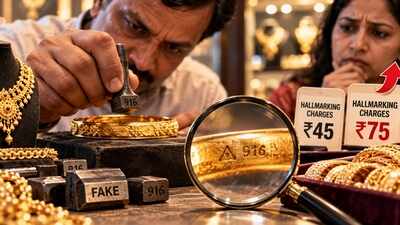
Gold hallmarking, a sign that allows you to verify the purity of the gold you are purchasing, has become costlier. And, the fallout of that is that there is a possible rise in fraudsters who are selling gold with fake stamps.The increase in gold hallmarking charges has raised concerns within the industry that the higher cost could encourage unscrupulous jewellers to resort to counterfeit hallmarking stamps.The concern is being considered particularly relevant in tier-2, tier-3 and tier-4 cities, where consumer awareness remains limited.
Gold hallmarking
Consumers bear the hallmarking cost when purchasing jewellery. However, many buyers are still unaware that they can verify the Hallmark Unique Identification (HUID) number through the Bureau of Indian Standards’ Care mobile application.Rajesh Rokde, chairman of the All-India Gem and Jewellery Domestic Council (GJC), told ET that awareness of the BIS app is adequate in only around 10% of the country’s 800 districts.This, he said, leaves consumers exposed as fraudsters develop increasingly sophisticated methods of copying hallmarking safeguards, including photographs.The GJC has taken up the matter with consumer affairs minister Pralhad Joshi and the BIS, asking that the earlier rate of Rs 45 per article be restored from the current Rs 75.The latest increase is a 66.67% hike, which the council said has added considerably to the compliance burden under a system that is mandatory.The industry body has also raised questions over whether the higher fee has resulted in a comparable improvement in consumer protection.Data from the government cited by the GJC shows that the number of recognised assaying and hallmarking centres (AHCs) rose to 1,577 in July 2026 from 1,220 in July 2022. During the same period, the cumulative number of gold articles hallmarked with HUID crossed 650 million.Hallmarking activity has grown significantly as well. A total of 132.2 million jewellery articles were hallmarked in 2025-26. Based on the revised fee, the GJC estimates that the additional financial burden on the ecosystem could be around Rs 400 crore, apart from approximately Rs 80 crore in GST.The GJC has asked the BIS to provide a detailed assessment of the costs underlying the revised charge, including expenditure on additional equipment, manpower, processing and storage. The council has also questioned the additional expense linked to mandatory photography, pointing out that photographs could potentially be copied or manipulated by fraudsters.According to the council, the turnaround time for hallmarking has also lengthened considerably, rising from around six hours earlier to 24-36 hours. This is resulting in jewellers’ working capital being tied up for longer periods and adding to their financing costs.The hallmarking fee for silver articles has not been changed and continues to be Rs 35.The revised rates were notified through the BIS (Hallmarking) Amendment Regulations, 2026, dated September 14, 2026.
Process of hallmarking
BIS hallmarking serves as a system for determining the purity of precious metal articles and certifying them under the Bureau of Indian Standards framework. A hallmarked article carries three important identifiers: the BIS logo, the karat or millesimal fineness and a six-digit alphanumeric Hallmark Unique Identification (HUID) number.Jewellers seeking to sell hallmarked jewellery are required to register with the Bureau of Indian Standards first. The registration process is entirely online. The jeweller files an application through the BIS portal, following which the registration is issued instantly and can be downloaded. No registration fee is charged, and once granted, the registration remains valid for the jeweller’s lifetime.After obtaining registration, the jeweller sends the jewellery to a BIS-recognised Assaying & Hallmarking (A&H) Centre for examination. The centre tests the articles to establish whether they conform to the prescribed standards. When an article clears the required tests, the A&H Centre applies the hallmark to the jewellery.