









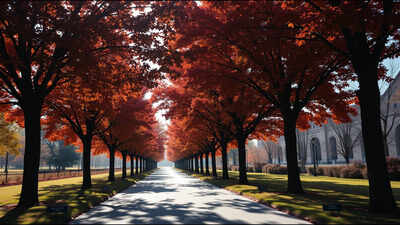
In 1920, the city of Washington planted 507 Norway maple trees along 16th Street NW to honour residents who had died in the First World War. The memorial was arranged by the District of Columbia Department of the American Legion, and the trees stretched in a row between Alaska Avenue and Varnum Street, each paired with a small bronze marker bearing the name of a fallen soldier. What began as a solemn tribute to more than 500 lives lost has since turned into an unusual environmental case study. Norway maple, native to Europe and western Asia, was never meant to travel far beyond the avenue where it was planted. Over the following century, its seeds drifted into nearby Rock Creek Park, where the tree has taken hold as one of the most persistent invasive species in the area, quietly altering the forest floor of the capital’s largest natural landscape.
How the 16th Street War Memorial trees came to be
The 16th Street memorial was dedicated on May 30, 1920, in a ceremony attended by roughly ten thousand District residents, complete with a parade and music from the United States Marine Band. According to the historical record kept by the Association of the Oldest Inhabitants of the District of Columbia, an additional group of soldiers was honoured two years later, on February 6, 1922, bringing the total closer to 530 names along the corridor. Each Norway maple was planted about forty feet apart across a stretch of roughly two and a half miles, creating a dense and uniform canopy that made 16th Street one of the city’s most recognisable tree-lined avenues. The markers were laid out in alphabetical order, running from the northern end of the corridor near Alaska Avenue to the southern end at Varnum Street, and at least six of them carry the names of women who served and died in the war. For decades, the row of maples served as a gathering point for Memorial Day remembrances, and the trees themselves grew into a living record of the war dead, predating most of the formal war memorials built later on the National Mall.
Why Norway maple became an invasive problem in Rock Creek Park
Norway maple was a popular choice for street planting in the early twentieth century because it grew fast, tolerated urban conditions well, and produced a dense, shady canopy that suited long formal avenues like 16th Street. Those same qualities, however, are what allowed it to spread aggressively once its winged seeds began drifting beyond the avenue and into the surrounding woodland. Unlike a native sugar or red maple, Norway maple leafs out earlier in spring and holds its leaves longer into autumn, giving it an extended window to capture sunlight before neighbouring trees are even in leaf. The Invasive Plant Atlas of the United States, a database maintained jointly by the University of Georgia and the National Park Service, now formally documents Norway maple as one of roughly forty non-native plant species recorded within Rock Creek Park. Once established in a forest setting, the tree grows quickly enough to shade out seedlings of native species, allowing it to dominate patches of the understorey that would otherwise support a wider mix of vegetation.
What the spread means for native trees and forest biodiversity
The presence of Norway maple in a natural woodland is not simply a matter of one species quietly replacing another. Its dense canopy blocks sunlight before native trees such as oaks, hickories and tulip poplars can establish themselves, while its shallow, spreading roots and the chemicals it releases into the soil make it difficult for wildflowers and shrubs to grow underneath. Forest surveys around Rock Creek describe patches where little grows beneath a stand of mature Norway maples besides bare, compacted ground, a pattern that reduces the food and shelter available to birds, insects and small mammals that depend on native plant diversity. Native maples, by contrast, support far more species of butterflies and moths, since local insects have evolved alongside them over thousands of years. A century after the 16th Street trees were planted as a tribute to the fallen, their descendants in Rock Creek Park now stand as a quiet reminder of how a well-intentioned planting choice, made without knowledge of its long-term ecological consequences, can reshape an urban forest even as the original memorial continues to honour those it was built for.