










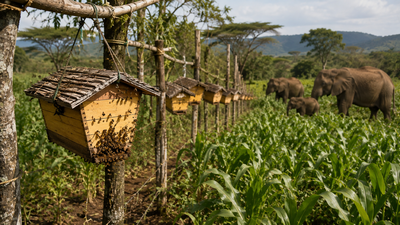
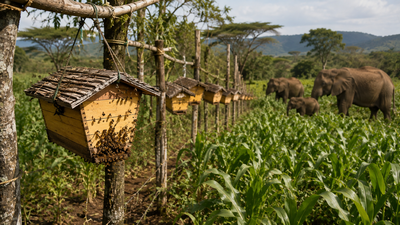
In the dry farming country beside Kenya’s Tsavo East National Park, the boundary between crops and wildlife can become difficult to hold. Elephants move through the landscape in search of food and water, and cultivated fields can become particularly attractive when crops are growing. In 2024, a nine-year study offered unusually long-term evidence that something as simple as a line of working beehives could help. The idea is based on an instinctive response: elephants generally avoid disturbed honey bees, particularly when the insects begin to swarm around sensitive parts of the face. But the same research also revealed a less straightforward picture. The fences worked best when the colonies were healthy, while drought, landscape disturbance and changing conditions could weaken the protection.
How 365 beehives helped reduce elephant crop raids in Kenya
According to the study published in Conservation Science titled ‘Impact of drought and development on the effectiveness of beehive fences as elephant deterrents over 9 years in Kenya ’, examined 3,999 elephant encounters around farms in two villages near Tsavo East National Park. The study reported that the fences deterred an average of 76.04% of elephants over the full period, rising to 86.27% during the main crop-growing seasons.As per the University of Oxford’s Department of Biology, which highlighted the findings in October 2024, the approach was described as a nature-based method that could protect both farms and wildlife. Its report, “Beehive fences effectively reduce human-elephant conflict, but the future holds risks for the strategy,” noted that elephants avoided the fences during peak crop seasons up to 86% of the time. The report also carried a warning from Dr Lucy King that “increased habitat disturbance or more frequent droughts could reduce the effectiveness” of the method.
Why working beehives were more than just a barrier around crops
A beehive fence is not simply a row of boxes placed around a field. In the Kenyan study, working and dummy hives were linked by wire, creating a structure that could respond when an elephant pushed against it. The movement could shake the connected hives and disturb the bees. Even the sound of disturbed bees can be enough to make elephants retreat, according to earlier work cited by the researchers. The study used farms in Mwakoma and Mwambiti in the Sagalla community. The researchers eventually monitored 26 farms, with each protected plot surrounded by between 12 and 15 hives. The fences were placed around portions of farmland that were particularly vulnerable to elephant incursions. Some small gaps had initially been left near houses, but these became potential entry points. Later, strips of tin cans containing stones were added to close those openings and create another source of noise.The attraction of the system for farmers went beyond protection. Bees could pollinate crops and produce honey that could be sold. Across the nine years, the 365 hives used at the height of the project produced about one tonne of raw honey, generating approximately US$2,250 in income for the participating farmers. That meant the fence had a practical agricultural value even when elephants were not nearby. The researchers also noted that beehive fences could support native honey bees and provide an additional livelihood stream.
How 3,999 elephant encounters revealed the effectiveness of beehive fences
Between June 2012 and December 2020, the project recorded 675 distinct crop-raiding events involving 3,999 elephant encounters. Of those encounters, 1,007 elephants, or 25.18%, broke through the beehive fence and entered protected sections of farms. By comparison, 2,649 encounters ended with elephants either remaining outside the farm boundary or entering the control portions of the farms. Another 343 elephants entered through gaps rather than breaking the fence itself.That produced an average annual deterrence rate of 76.04%. The result was stronger during the period when farmers most needed protection. Across six peak crop-growing seasons, the average deterrence rate was 86.27%, although individual seasons varied considerably. In one season, the fences stopped every approaching elephant recorded in the study, while the weakest peak-season performance came later, when only 71.8% were deterred.The researchers were also able to see how small changes to the fence could matter. Before the additional tin-can barriers were installed, elephants sometimes entered through open ends rather than forcing their way through the hives. After those gaps were closed, the number of elephants entering through them fell sharply, from 343 over the preceding five years to five in 2019 and 11 in 2020. It was a relatively simple adjustment, but it removed a weakness in the original arrangement.The findings were summarised by the study itself in a particularly important sentence: “Beehive fences are very effective at reducing up to 86.3% of elephant crop-raids during peak crop seasons after good rainfall.” That qualification matters. The number describes an average under particular conditions, rather than a guarantee that every beehive fence will work in the same way.
Why only 20.29% of Kenya’s 350 hives were occupied during the 2017 drought
A drought began after the rains failed in late 2016. In 2017, the study area received only 288 millimetres of rain, compared with an average of about 691 millimetres across the other eight years. Hive occupation fell dramatically. During the drought year, only 20.29% of the 350 hives were occupied by bees at least once. The relationship between drought and elephant deterrence was not as simple as saying that fewer bees immediately meant more elephant raids. Poor rainfall also meant poor crop growth, which made the farms less attractive to elephants. During the drought season, the fences still deterred 86.27% of approaching elephants. The researchers therefore cautioned against interpreting that figure as evidence that weak or empty hives were equally effective. The circumstances themselves had changed.The following season demonstrated the problem more clearly. Good rainfall brought healthier crops and more attractive farmland, while the bee colonies had not yet recovered fully from the drought. From November 2018 to January 2019, the farms recorded 1,833 elephant encounters. Hive occupation had recovered only to 28.2%, and 28.4% of approaching elephants broke through the fences. The resulting deterrence rate was just 71.8%, the lowest recorded during the six peak crop seasons.The study described this combination as a “perfect storm”: weak bee colonies recovering from drought, unusually large elephant groups and productive crops following good rains. It is this part of the evidence that gives the 2024 findings their cautionary edge. The fence depends on a living biological system, and that system depends partly on rainfall, flowering plants and the wider environment. The impact was also visible in honey production. In the three years before the drought, the fences produced 812.37 kilograms of honey from 338 hives. In the three years afterwards, production fell to 187.68 kilograms despite the larger number of hives in operation. Across the full nine-year period, production reached 1,000.1 kilograms, generating roughly US$2,250 for the 26 farmers.
How drought and environmental change could limit beehive fences in Kenya
The study therefore did not present beehive fences as a permanent answer to human-elephant conflict. Instead, its nine years of observations showed both sides of the approach. Working colonies can provide a remarkably effective deterrent, especially during crop seasons. Yet drought and environmental disturbance can affect the bees that make the system work in the first place. As the researchers wrote, worsening drought could make beehive fences “a less versatile solution to HEC” in the future.For the University of Oxford and the research team, that is where the significance of the 2024 study lies. The fences offer farmers a way of reducing elephant incursions without simply trying to remove elephants from the landscape, while the honey can provide an economic return. But their success is tied to conditions beyond the fence itself. Maintaining healthy colonies, designing the barriers properly and accounting for changing rainfall and land use all become part of whether the method continues to work. The research was conducted by Save the Elephants in collaboration with the Wildlife Research and Training Institute, Kenya Wildlife Service and the University of Oxford. Its authors concluded that beehive fences should form part of the wider range of tools available to small-scale farmers, while recognising the management and maintenance needed to keep them effective. The 2024 evidence therefore presents the method neither as a simple fix nor as a failed experiment, but as a strategy whose usefulness depends on keeping the bees and the surrounding landscape in conditions where they can do their job.