










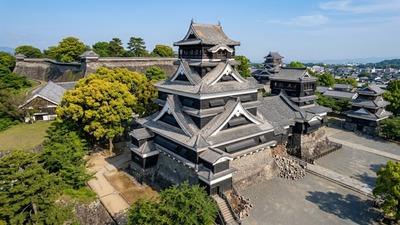
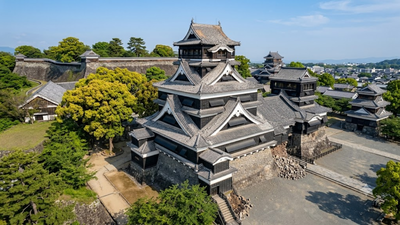
Over the past 400 years, Kumamoto Castle has been an ever-present landmark in Kumamoto City and has gained the reputation of being one of the best castles in Japan and a masterpiece of samurai warfare architecture. The castle was built to withstand the attacks of armies with stone walls and a complicated design that could not be easily attacked. However, throughout this time, the castle has had to withstand much more than battles: earthquakes. The devastating 2016 Kumamoto earthquakes left the centuries-old landmark badly damaged, triggering one of Japan’s largest cultural restoration projects. A decade later, another powerful earthquake struck the region in July 2026, once again damaging the historic fortress and highlighting the constant challenge of preserving cultural heritage in one of the world’s most seismically active countries. Kumamoto Castle remains a powerful symbol of resilience despite repeatedly being tested by history and nature alike.
Built by a legendary samurai, Kumamoto Castle became one of Japan’s strongest fortresses
Kumamoto Castle was constructed under the orders of one of the best warriors in Japan, Katō Kiyomasa, in the year 1601 and was completed mainly in 1607.Instead of building an imposing abode, he built the entire structure with an intent of making it a defensive fortress. The castle is most renowned for its curved stone walls referred to as musha-gaeshi, which mean “warrior-deflecting slopes”. These walls became increasingly steep towards the top, making them virtually impossible to climb.At its peak, the castle complex stretched across nearly one million square metres, containing dozens of turrets, gates, storehouses, residences and defensive structures. It soon became one of the most formidable castles in feudal Japan.
The fortress survived wars but suffered devastating damage during the 2016 earthquakes
Kumamoto Castle proved its military strength during the Satsuma Rebellion of 1877, when government troops successfully defended it against thousands of samurai led by Saigō Takamori. Although the defenders held the fortress, much of the castle was later destroyed by fire during the conflict, leaving only a handful of original structures standing.As reported by the BBC, its greatest modern disaster arrived in April 2016, when a magnitude 6.5 foreshock was followed just 28 hours later by a 7.3 mainshock, devastating Kumamoto Prefecture. The earthquakes caused widespread destruction across the castle complex. Stone walls collapsed in hundreds of locations, roof tiles crashed from historic buildings, decorative roof ornaments were dislodged, and several important turrets suffered severe structural damage.All 33 major buildings on the castle premises were damaged, along with more than 800 units of stone walls that either fell down or were made unstable by the earthquake. The destruction made Kumamoto Castle one of the most challenging restoration efforts undertaken in Japan, as the process is estimated to last until the mid-century.
The recent 2026 earthquake damaged the castle once again
However, before the process of rehabilitation from the 2016 tremor had been completed, Kumamoto Castle experienced another earthquake in July 2026, this time hitting southern parts of Japan. According to The New York Times, the quake resulted in the collapse of some parts of the historical walls of the castle, causing huge clouds of dust to rise up in the sky above the ancient building. As a response to the damage done, the authorities had no choice but to close Kumamoto Castle to visitors and evaluate the state of the structure.Indeed, although the recent tremor caused fewer damages than its predecessor in 2016, it put back on the drawing board the project of rehabilitation of the castle. Most of the building had been restored over ten years with great attention to detail. Indeed, it was a complex process since conservators had to reconstruct the collapsing walls stone by stone. However, the current situation shows once again how hard it is to preserve ancient monuments in a country frequently experiencing earthquakes.
Restoring Kumamoto Castle has become one of Japan’s largest conservation projects
Unlike conventional rebuilding, the restoration of Kumamoto Castle focuses on preserving as much of the original structure as possible.Thousands of fallen stones from collapsed walls have been individually numbered, catalogued and mapped so they can be returned to their original positions. Engineers combine historical documents, old photographs and modern surveying technology to reconstruct walls exactly as they stood before the earthquakes, while discreet seismic reinforcements are added where necessary.The restoration is intended not simply to repair earthquake damage but to preserve one of Japan’s most important historical monuments for future generations.Today, visitors can explore specially designed reconstruction routes that allow them to observe both the restored sections and the ongoing conservation work, providing a rare opportunity to witness one of the world’s largest heritage restoration efforts in progress.