










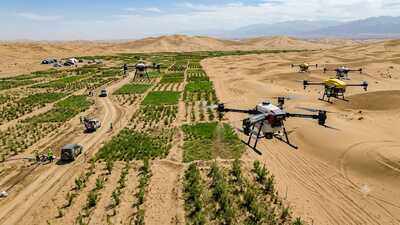
For decades, the Taklamakan Desert has symbolised one of nature’s harshest environments, a vast expanse of shifting sand where strong winds, scarce rainfall and extreme temperatures make vegetation difficult to establish. Today, however, new technology is changing how restoration is carried out. Across parts of China’s Xinjiang Uygur Autonomous Region, drones are being deployed to sow seeds across difficult terrain, allowing workers to restore vegetation more quickly and safely than traditional methods. The approach forms part of China’s broader campaign to combat desertification, combining ecological engineering with modern technology to stabilise sand dunes, restore degraded landscapes and create new opportunities for local communities.
How drones are helping transform one of the world’s largest shifting sand deserts
According to reports from Global Times, drone seeding is becoming an increasingly important tool in China’s afforestation efforts. Instead of relying entirely on manual planting in remote and inaccessible areas, drones can distribute seeds efficiently across large stretches of desert while reaching locations that are difficult for vehicles or workers to access.The wider greening campaign also incorporates technologies such as light detection and ranging (LiDAR), satellite mapping and algorithm-based planning to identify the most suitable locations for restoration. These tools help improve planting efficiency while increasing the survival rates of newly established vegetation. As Global Times notes, technological innovation is now playing a central role in expanding China’s “green assets” and strengthening its fight against desertification.
Restoring life along the edge of the Taklamakan
The drone programme is part of broader ecological restoration work taking place around the Taklamakan Desert, the world’s second-largest shifting sand desert. In counties such as Yutian, local communities have spent years planting drought-resistant species including tamarisk, a hardy shrub that helps stabilise loose sand while supporting the cultivation of cistanche, a valuable medicinal plant often called “desert ginseng.“Restoration projects increasingly combine scientific techniques, including drip irrigation, improved planting layouts and optimised cultivation methods, with traditional ecological knowledge. These measures have significantly improved plant survival while creating new economic opportunities for local residents through ecological agriculture and medicinal plant production.
Technology and ecology working together
In recent years, China has increasingly combined precision technologies with traditional tree-planting techniques in its desert restoration projects. Drones are being used to disperse seeds across sandy terrain after seasonal rainfall, allowing vegetation to establish more efficiently. The overall greening effort in China has seen the use of artificial intelligence, satellite monitoring, and ecological modeling to ensure efficient implementation of the afforestation project.According to the National Forestry and Grassland Administration, during the 14th Five-Year Plan (2021-2025), China planted 185 million mu (about 12.3 million hectares) of forests.
A greener future for one of Earth’s harshest landscapes
Although the Taklamakan continues to be an extreme desert, advances in ecological restoration science and restoration technology prove that, by employing innovative techniques and long-term planning, even severely damaged environments can be revived. Drone seeding is not a single remedy for this problem; it is just another method which enables restoration workers to perform their job more quickly and effectively in regions which used to be difficult to access.In addition to the positive effect it has on the containment of drifting sand, the return of vegetation in the desert brings additional advantages such as increased biological diversity, protection of agricultural lands around the region, reduction of dust storms, and creation of sustainable employment opportunities for local people.